

7 Best Comfortable Dog Harnesses for Puppies 2026

Table of Contents
- Quick Comparison: Top Puppy Harnesses for 2026
- How to Measure for a Dog Harness Correctly
- 1. Reflective Puppy Harness: Best for Small Breeds
- 2. No Pull Service Dog Vest Harness: Best for Training
- 3. Pet Harness and Leash Set: Best Complete Kit
- Cons:
- Puppy Harness Training Tips for Positive Reinforcement
- When to Switch from Collar to Harness
- Frequently Asked Questions
Last Updated: September 29, 2026
Quick Comparison: Top Puppy Harnesses for 2026
Finding one of the 7 best comfortable dog harnesses for puppies 2026 has to offer starts with what your growing dog needs. The right harness spreads pressure across the chest instead of the throat, adjusts as your puppy grows, and stays put during zoomies.
Here is the short version before we get into the details:
| Harness | Price | Best For | Key Feature |
|---|---|---|---|
| Reflective Puppy Harness | $20.00 | Small breeds, night walks | Reflective stitching, padded chest strap |
| No Pull Service Dog Vest Harness | $12.06 | Training, outdoor walking | Breathable soft vest, no-pull design |
| Pet Harness and Leash Set | Listed at $0.00 | Complete starter kit | Harness plus matching leash |
Below, we break down how to measure correctly, what separates a good harness from a bad one, and how to build leash manners without scaring your puppy.

How to Measure for a Dog Harness Correctly
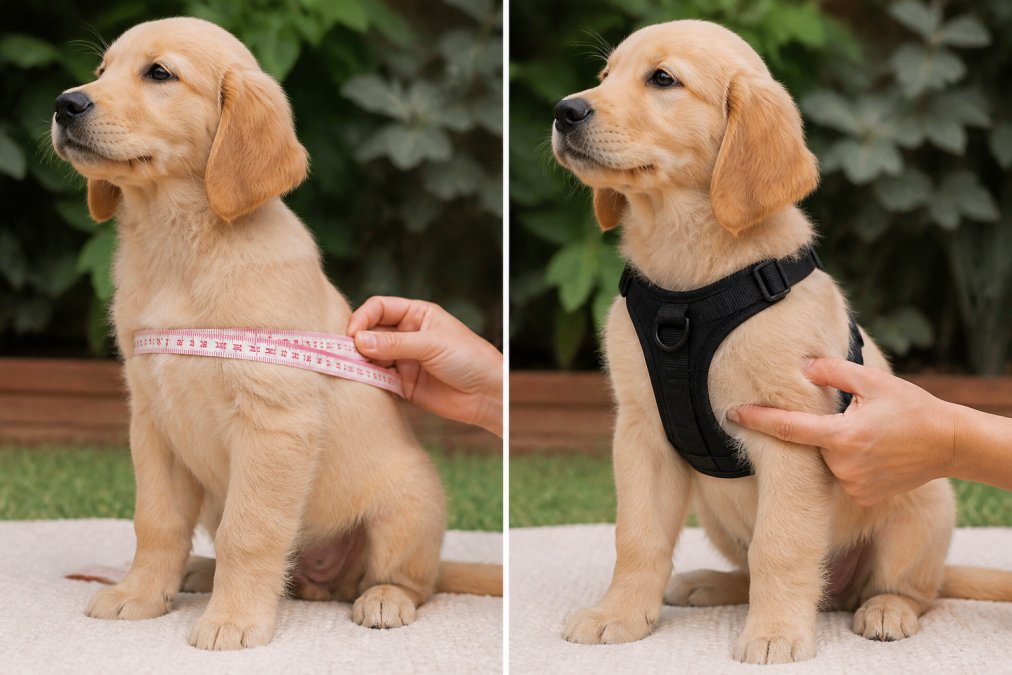
Learning how to measure for a dog harness correctly takes two minutes and one soft tape measure. You need two numbers: girth around the widest part of the ribcage, and neck circumference at the base of the neck. Measure girth first, it determines the primary fit.
A few practical notes from experience:
- Measure at the end of the day, when your puppy is calm. A wiggly puppy adds inches that are not there.
- Leave room for the two-finger rule: you should fit two fingers under any strap without forcing them.
- Re-measure every two to three weeks. Puppies grow fast, and a snug harness becomes a tight one quickly.
- Check the size chart for each specific harness, because sizing varies between designs.
AVMA guidance on pet safety and equipment notes that properly fitted gear matters for a dog's comfort and joint health during growth.
The growth-stage sizing guide most guides skip
Almost no harness roundup tells you this: a puppy's girth does not grow steadily, and the first six months are when fit drifts fastest. A harness that fits at 10 weeks can be uncomfortably tight by 16 weeks even if the puppy gained only a few pounds, because chest depth expands faster than body weight.
A workable resizing cadence looks like this:
| Puppy age | Typical girth change | Resize check |
|---|---|---|
| 8-12 weeks | Rapid, week over week | Every 7-10 days |
| 3-4 months | Steady but noticeable | Every 2 weeks |
| 4-6 months | Slowing, breed-dependent | Every 3 weeks |
| 6-12 months | Approaching adult size | Monthly |
These are general patterns, not breed-specific predictions, a Great Dane puppy and a Chihuahua puppy move through them at very different speeds.
Front-clip vs. back-clip: how attachment point changes fit
- Back-clip harnesses attach at the shoulder blades. Fit is more forgiving because the pull force runs along the spine. These are the easier choice for a puppy still learning to walk on a leash, and they are what most step-in and overhead designs use.
- Front-clip harnesses attach at the chest. When a puppy pulls, the leash redirects the body sideways rather than forward, which discourages pulling. The trade-off is that fit has to be tighter and more precise, a loose front-clip harness slides sideways and stops redirecting anything.
1. Reflective Puppy Harness: Best for Small Breeds
For small breeds and evening walks, the Reflective Puppy Harness from Shake Wag & Roll is our top pick. At $20.00, it wraps a small pup in soft, padded comfort instead of pulling on the neck, and reflective stitching keeps your dog visible on morning and evening strolls.
Pros:
- Lightweight construction your puppy barely notices
- Reflective stitching for low-light visibility
- Padded chest strap reduces neck strain
Cons:
- Designed for small breeds, so it is not suited to larger puppies
2. No Pull Service Dog Vest Harness: Best for Training
If your puppy pulls, the No Pull Service Dog Vest Harness is the training-focused choice at $12.06. Its breathable soft vest spreads pressure across the body, discouraging pulling without choking by redirecting forward momentum rather than fighting it.

Pros:
Reflective Puppy Harness – Safe, Soft & →
- No-pull design helps reduce pulling over time
- Breathable soft fabric for outdoor walking
- Low price point for a training harness
Cons:
- Vest designs can feel warmer than minimal strap harnesses in summer heat
3. Pet Harness and Leash Set: Best Complete Kit
The Pet Harness and Leash Set bundles a harness and matching leash in one purchase, the simplest way to get started. The adjustable no-pull design suits dogs and cats for walking and basic training.
Pros:
- Harness and leash included together
- Adjustable no-pull design
- Works for both dogs and cats
Cons:
Puppy Harness Training Tips for Positive Reinforcement
Puppy harness training tips work best when you pair the harness with treats and praise, not pressure. Positive reinforcement means rewarding the behavior you want rather than correcting what you don't. Start indoors, where distractions are low.
Follow this sequence:
- Let your puppy sniff the harness and reward calm curiosity.
- Drape the harness over your puppy's back without buckling it, then treat.
- Buckle it loosely and immediately reward, then remove it.
- Repeat over several short sessions until the harness predicts treats.
- Clip the leash on indoors and take a few steps, rewarding loose leash position.
- Move to the yard, then the sidewalk, keeping sessions under five minutes.
When to Switch from Collar to Harness
Switch from a collar to a harness as soon as your puppy pulls or coughs on the leash. Collars concentrate force on the throat, which is fragile in a growing dog; a harness spreads that force across the chest and shoulders, which is why most trainers now recommend harnesses from the start.
The safety angle most harness guides ignore: chewing and material toxicity
Puppies chew the harness straps, buckles, D-ring, and anything dangling within reach, two safety considerations almost no harness roundup addresses.
- Frayed or fuzzy webbing along the chest strap
- A buckle that no longer clicks firmly or has visible cracks
- A D-ring that rotates loosely or shows deformation
- Chew marks on any load-bearing strap
Why the attachment point matters for a growing skeleton
A puppy's skeleton is still developing through the first year, and where the leash attaches changes how force travels through the body.
- Back-clip harnesses route pull force along the spine and shoulders. This is the gentler default for a puppy whose growth plates are still open, because the load spreads across a broad, structurally strong area.
- Front-clip harnesses redirect force sideways across the chest. This is effective for discouraging pulling, but it applies asymmetric pressure when the dog lunges. Used briefly during training, that is fine. Used as the only attachment on a puppy that pulls constantly, it can create uneven loading.
Frequently Asked Questions
What type of harness is best for a puppy?
A step-in or overhead harness with adjustable straps works best for puppies. Look for soft padding, a padded chest plate, and a quick-release buckle. A no-pull mechanism helps with leash manners during training. Measure your puppy's girth and neck circumference before buying. The Reflective Puppy Harness at $20 offers a lightweight, escape-proof fit for small breeds. Prioritize comfort and adjustability for rapid growth stages.
At what age can a puppy start wearing a harness?
Most puppies can wear a harness from 8 weeks old, once they have their first vaccinations and your veterinarian approves. Start with short sessions at home using positive reinforcement. A lightweight construction like the No Pull Service Dog Vest Harness at $12.06 works well for early training. Always supervise initial wear and check for chafing. Switch from collar to harness early to protect your puppy's neck.
How do I know if my puppy's harness fits correctly?
Use the two-finger rule: you should fit two fingers between the harness and your puppy's body. Check the girth measurement and neck circumference. The harness should be snug but not tight, with no twisting or gaps. Adjustable straps help accommodate growth. Do a fit test every two weeks because puppies grow fast. A poorly fitted harness can cause chafing or allow escape.
Are front-clip harnesses better for puppy training?
Front-clip harnesses redirect pulling to the chest, which helps with leash manners and reduces neck pressure. They are choke-free and support positive reinforcement training. However, some puppies adapt better to back-clip designs. The No Pull Service Dog Vest Harness offers a no-pull mechanism suitable for training. Combine either style with treat-based rewards for best results.
Should a puppy wear a harness all the time?
No. Puppies should only wear a harness during walks, training, or supervised outdoor time. Constant wear can cause chafing, matting, and restrict movement. Remove the harness for naps, crate time, and play. Check for redness or irritation after each use. A breathable mesh or padded chest plate design like the Reflective Puppy Harness reduces risk during wear.
Picking a comfortable harness is one of the simplest ways to make walks easier for both of you. The right fit takes two minutes to measure and pays off for months of growing. Shake Wag & Roll carries the Reflective Puppy Harness for small breeds, the No Pull Service Dog Vest Harness for training, and the Pet Harness and Leash Set for a complete start, all selected by pet lovers who test what they sell. Explore the collection and find the harness that fits your puppy today.