

How to Calm an Anxious Dog with Natural Treats

Table of Contents
- Why Natural Treats Work for Dog Anxiety Training with Treats
- Teaching a Dog to Take Treats Gently
- Choosing Natural Calming Treats for Dogs
- How to Introduce New Dog Treats Without Upsetting Digestion
- Spotting Digestive Reactions and Knowing When to Call Your Vet
- Building a Calm Routine Around Treat Time
- Frequently Asked Questions
Last Updated: October 12, 2026
Why Natural Treats Work for Dog Anxiety Training with Treats
If you want to know how to calm an anxious dog with natural treats, the answer starts with what you're actually feeding.
That matters more than most owners realize. Anxious dogs often have sensitive digestion, and a treat that upsets the gut makes anxiety worse, not better.
Natural treats help for three reasons:
- They're predictable. Fewer ingredients means fewer surprises.
- They support positive reinforcement. You can reward calm behavior without worry.
- They work with training, not against it. A calm dog learns faster.
The key is pairing the right treat with the right training method. Let's walk through both.
Teaching a Dog to Take Treats Gently
A dog that grabs and nips at treats is not a lost cause. Gentle treat-taking is a learned skill, and most dogs pick it up in a few short sessions.
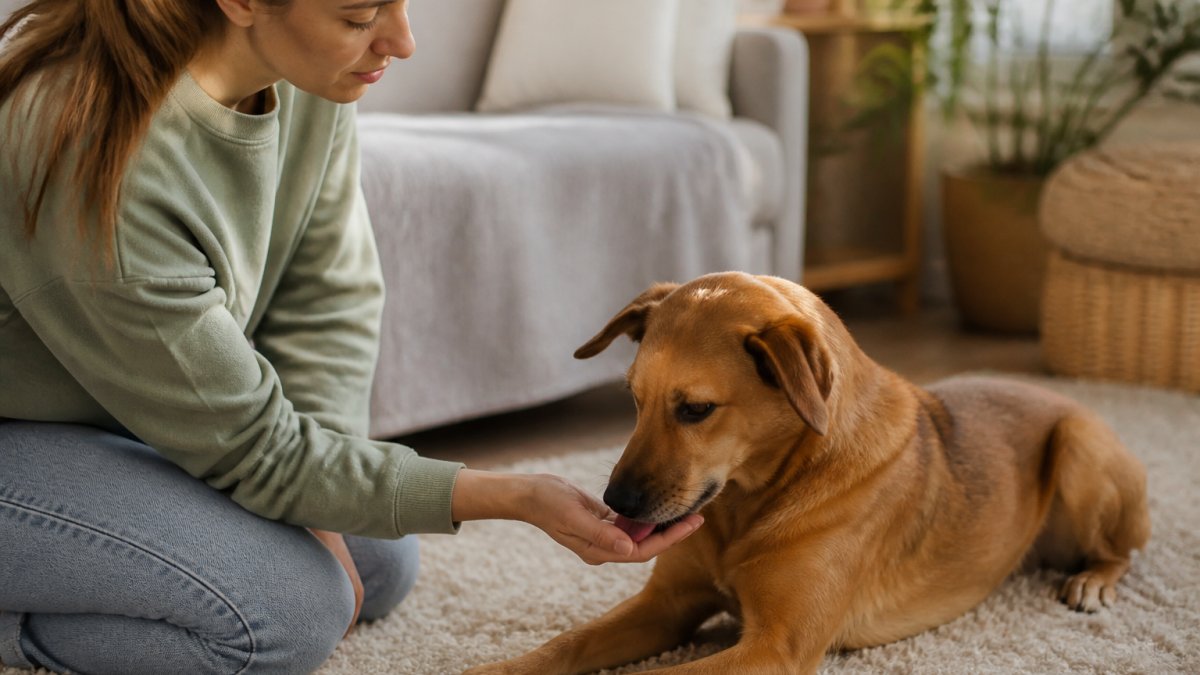
Start with a treat your dog really wants, something small and smelly. Hold it in a closed fist. Let your dog sniff, lick, and nudge.
Repeat this 3-5 minutes at a time, a few times a day. Short sessions beat long ones.
The Closed Fist Method and the Gentle Cue
The closed fist method works because it removes access. Your dog learns that calm behavior, not grabbing, earns the reward.
Here's the sequence:
- Hold the treat in a closed fist at your dog's nose level.
- Wait for stillness. No jumping, no nipping.
- Say "gentle" in a soft, even voice.
- Open your hand flat and let them lick the treat off your palm.
- Praise quietly. Loud praise can spike excitement.
Use the word "gentle" every single time. Within a week or two, most dogs connect the cue to the behavior.
Choosing Natural Calming Treats for Dogs
Natural calming treats for dogs are not magic pills. They're simply treats made from whole ingredients that support a settled stomach and a steady routine, which is what actually helps an anxious dog.
Look for short ingredient lists. Oat flour, pumpkin, peanut butter, molasses, coconut oil, and cinnamon are all common and easy to read. Skip anything with a long list of artificial additives.
Some of our favorites at Shake Wag & Roll include:
- Dog Macarons (Bonne et Filou) - handmade with human-grade ingredients, corn-free and wheat-free, and hard enough to give a dog real chewing time. Break them in half for small or senior dogs.
- Portland Pet Food Company Pumpkin Biscuits - made with garbanzo bean flour, pumpkin, peanut butter, molasses, and cinnamon. Simple and easy on most stomachs.
- Cookie Pal Pumpkin Chia Treats - organic, gluten-free, and made with pumpkin, chia, and ginger. A solid pick for dogs with wheat sensitivities.
Ingredient and Allergy Screening Before You Buy
Before you buy any new treat, run a quick screen. It takes two minutes and saves you a rough night.

- Check the protein source. Chicken, beef, and dairy are common triggers.
- Look for "limited ingredient" or "single protein" labels.
- Avoid artificial colors, preservatives, and unnamed "meat meal."
If your dog has a known allergy, talk to your vet before introducing anything new.
How to Introduce New Dog Treats Without Upsetting Digestion
Learning how to introduce new dog treats comes down to one rule: go slow, and change only one variable at a time. A new food needs time, even a "natural" one, because a dog's gut bacteria and digestive enzymes adjust gradually rather than overnight.
A measured ramp can catch problems in the first 48 hours, before a small reaction becomes a messy one. Here is a framework to consider.
Step 1: Set a Baseline Before You Start
You cannot judge a reaction if you do not know what normal looks like. For three days before introducing anything new, note:
- Stool quality (firm, soft, loose, or watery) and how many times per day
- Appetite at meals
- Energy level during walks and play
Write it down. A phone note works fine. This baseline is what you compare against later.
Step 2: Pick One Treat and One Protein
Introduce a single new treat at a time. If your dog already has a known trigger, chicken, beef, and dairy are the most common, choose a treat built on a protein your dog has eaten without issue before.
Do not introduce two new treats at once. If your dog reacts, you will not know which one caused it, and you will have to start the whole test over.
Step 3: The Seven-Day Transition Schedule
A seven-day schedule can give slower digestions room to adjust. Portion sizes below assume a medium dog (roughly 30-50 lb); scale down for small dogs and up for large ones.
| Day | Portion Size | Timing | What to Watch |
|---|---|---|---|
| Day 1 | One piece the size of a pinky nail (about 1/4 inch) | Morning, after a normal meal | Energy, appetite, stool the next morning |
| Day 2 | Two pieces, same size | Split morning and afternoon | Stool firmness, any gas |
| Day 3 | Three pieces | Split across two sessions | Gurgling, stool color, coat |
| Day 4 | Four to five pieces | Spread across the day | Itching, paw licking, mood |
| Day 5 | Half of a normal training portion | During a short training session | Overall behavior, stool |
| Day 6 | Full training portion | Normal training session | Same as above |
| Day 7 | Normal portion, used as a regular reward | As needed | Confirm no delayed reaction |
If anything looks off, stop and go back one day. If problems continue for more than 24 hours after you pull the treat, stop it entirely and call your vet.
Step 4: Know When to Pause, Not Push Through
Pause the schedule and hold at the last tolerated portion if you see:
- Softer stool than baseline, but not diarrhea
- Mild gas or gurgling
- A slight drop in enthusiasm for the treat
Stop the treat and call your vet if you see:
Dog Macarons - Count of 6 (Dog Treats | Dog Gifts) →
- Diarrhea lasting more than 24 hours
- Vomiting more than once
- Refusing meals for more than a day
A "natural" label does not mean a treat is safe for every dog. Pumpkin, peanut butter, and coconut oil are all common ingredients that some dogs still react to. The label tells you what is in the treat, not how your individual dog will handle it.
Step 5: Adjust Duration and Portion Over Time
Once a treat is cleared, you do not have to keep it at the training portion forever. Two adjustments matter:
- Chews: Start with five minutes of chewing, then take the chew away. Add two to three minutes per session over the following week. Long chew sessions on a new item can overwhelm a sensitive gut even when the ingredient is fine.
- Training treats: If you are rewarding frequently, keep each piece small, roughly the size of a pea, so the total volume stays modest. A dozen pea-sized treats is far less food than a dozen biscuit halves.
For a sensitive stomach, the treat itself is only half the story. How fast you introduce it, how small you keep the pieces, and how quickly you pull back when something changes matter just as much as what is in it.
Spotting Digestive Reactions and Knowing When to Call Your Vet
A reaction to a new treat can show up in two different systems, and they do not always appear together.
Digestive reactions show up in the gut: soft stool, diarrhea, gas, gurgling, vomiting, or a sudden drop in appetite.
Immune reactions show up on the skin or in the airway: itching, hives, paw licking, ear redness, facial swelling, or difficulty breathing.
What to Monitor, Day by Day
For the first three days after any new treat, check these four things each morning:
- Stool, compare firmness, color, and frequency against your baseline
- Appetite, did your dog finish normal meals?
- Skin, any new scratching, licking, or redness?
- Energy, normal walks and play, or sluggish?
A single soft stool after a new treat is not automatically a red flag. A pattern across two or more days is.
When to Stop the Treat and Call Your Vet
Call your vet right away if you see any of these:
- Blood in the stool or black, tarry stool
- Repeated vomiting, or vomiting with lethargy
- Swelling around the face, lips, or eyes
Those signs can point to a serious allergy or a blockage, and they are not something to wait out. For questions about whether a specific ingredient is toxic, the ASPCA Animal Poison Control Center is a good first stop.
The Treat-Testing Log
A written log can help you track patterns to show your vet. Keep it simple, five columns, one row per treat given.
| Date | Treat & Ingredient | Portion | Time Given | Next-Day Notes |
|---|---|---|---|---|
| 10/12 | Pumpkin biscuit (garbanzo, pumpkin, PB) | 1 pinky-nail piece | 8:00 AM | Stool firm, normal energy |
| 10/13 | Same | 2 pieces | 8:00 AM, 4:00 PM | Slight gas in evening |
| 10/14 | Same | 2 pieces (held) | 8:00 AM, 4:00 PM | Gas resolved, stool firm |
After two to three weeks, the log can help you identify which treats your dog tolerates and which ones consistently cause a reaction. Bring it to your vet if you are trying to identify a suspected allergy, it can be a useful tool.
When to Involve Your Vet Before Testing Anything
Some dogs should not be part of a home treat trial at all without veterinary guidance:
- Dogs with a diagnosed condition such as inflammatory bowel disease, pancreatitis, or kidney disease
- Dogs on a prescription or hydrolyzed-protein diet
- Dogs with a history of severe allergic reactions
If your dog falls into any of those groups, talk to your vet before introducing a new treat. A veterinarian can also help distinguish a true food allergy from a sensitivity, which changes how you approach the trial.
A treat-testing log is the cheapest diagnostic tool you have. Two weeks of notes will tell you more about your dog's triggers than any label claim on the package.
Building a Calm Routine Around Treat Time
An anxious dog calms down when the day is predictable. Treat time is one of the easiest places to build that predictability.
Set a rhythm:
- Same time each day for training sessions
- Same quiet spot, away from the doorbell and the window
- Same calm voice and slow movements
Pair the routine with gentle handling. Sit on the floor. Let your dog come to you. Reward the calm, not the excitement.
Over time, the routine itself becomes the signal. Your dog starts to relax before the treat even comes out.
For more on choosing treats and building a calm home routine, the American Kennel Club's guide to dog training is a helpful reference.
Frequently Asked Questions
How can I use treats to help calm an anxious dog?
Pair a small, high-value treat with a calm moment, not with the thing that scares your dog. When your dog settles on their mat during a thunderstorm or a visitor's arrival, mark that calm behavior with a soft "yes" and one treat. Over repeated sessions, the treat becomes a reward for staying relaxed. Keep portions small so you can repeat the exercise 10 to 15 times without overfeeding, and work below your dog's anxiety threshold so they can still think and eat.
What natural treats are safe for anxious dogs?
Look for single-ingredient or short-list treats your dog has already tolerated, such as plain cooked chicken, small pieces of apple, blueberries, carrots, or peas. Pumpkin biscuits and limited-ingredient baked treats also work well. Check the label for corn, wheat, and artificial preservatives if your dog has reacted before, and introduce any new treat in a pea-sized portion first. Treats are not a substitute for veterinary care if anxiety is severe or sudden.
How do I introduce a new treat to a dog with a sensitive stomach?
Start with one treat broken into a small amount, about the size of a pea, and give it at a calm moment. Wait 24 hours and watch stool quality, appetite, and energy. If everything looks normal, increase to two or three pieces the next day, then build up over five days until you reach a normal serving. Keep the rest of your dog's diet unchanged during the test so you can tell what caused any reaction.
How should I give treats to a dog that takes them too roughly?
Close your hand around the treat and let your dog lick and nuzzle at your fist. The moment they stop mouthing and back off, open your palm flat and say "gentle" as they take the treat. Repeat for 3 to 5 minutes per session, two or three times a day. If teeth touch skin, close your hand again and pause for a few seconds. Most dogs learn within a week that a closed fist means no treat and a calm lick means the reward arrives.
An anxious dog needs two things from you: patience and the right tools. We built Shake Wag & Roll around both. Our community of dog lovers shares what works, and our shelves are stocked with the kind of treats you can feel good about handing over. From organic chews and limited ingredient diets to durable toys for the dogs who need an outlet, we've got the essentials. Sign up with Shake Wag & Roll and get expert care tips, exclusive offers, and first access to new drops.