

Is a Martingale Collar Worth It for Training?

Table of Contents
- What a Martingale Collar Actually Does (and Doesn't Do)
- Martingale Collar vs Flat Collar: What Changes on a Walk
- How to Fit a Martingale Collar Correctly (Step by Step)
- Safety Limits: Tracheal Pressure and Back-Out Prevention
- Which Dogs Benefit Most: Sighthounds, Escape Artists, and Pullers
- Best Dog Training Collars for Leash Pulling: What to Compare
- Common Mistakes and Long-Term Behavioral Dependency
- Verdict: Who Should Buy One, and Who Should Skip It
- Frequently Asked Questions
Last Updated: October 2, 2026
What a Martingale Collar Actually Does (and Doesn't Do)
A martingale collar is a limited-slip collar designed to tighten just enough to prevent a dog from backing out, then stop. The confusion starts here: owners expect a training device and get a safety device.
The question "is a martingale collar worth it for training" has a short answer: it's worth it for safety, not for teaching loose leash walking.
The limited-slip mechanism, explained in one minute
Two loops make up the collar. The larger loop sits around the neck; the smaller control loop connects to a metal loop that holds the leash. When your dog pulls, the control loop tightens the larger loop.
The tightening is bounded: unlike a choke chain, the martingale cannot close past a preset point, making it a limited-slip collar rather than an aversive tool.
Management tool first, training tool second
A management tool prevents an outcome, like a dog slipping its collar on a walk. A training tool teaches a behavior, like loose leash walking.
A martingale is firmly in the first category: it manages escape risk but teaches nothing about leash manners. Loose leash walking requires positive reinforcement, a training plan, and consistency, the collar just keeps your dog attached while you do that work.
Martingale Collar vs Flat Collar: What Changes on a Walk
The practical difference between a martingale collar and a flat collar comes down to one failure mode: back-out.
A martingale solves this with a snug fit that only tightens under load: it behaves like a flat collar on a normal walk, then closes to its limit under tension.
| Feature | Flat Collar | Martingale Collar |
|---|---|---|
| Fit at rest | Fixed size | Slightly loose |
| Fit under tension | No change | Tightens to a limit |
| Back-out prevention | Poor | Strong |
| Pressure distribution | Even | Spread across a wider band |
| Training effect | None | None |
Neither collar teaches anything. The martingale simply fails less often when a dog panics or reverses direction.
How to Fit a Martingale Collar Correctly (Step by Step)
Fitting is where a martingale earns its reputation or loses it: too loose lets a dog back out anyway, too tight sits on the throat all day. Here's our sequence.
- Measure your dog's neck circumference at the widest point, just behind the ears and under the jaw.
- Slide the collar over your dog's head, or fasten it if it has a buckle.
- Adjust the slider so the larger loop sits snug but not tight at rest.
- Pull the control loop until the two metal loops meet, and check the gap.
- Walk your dog and watch where the collar settles under tension.
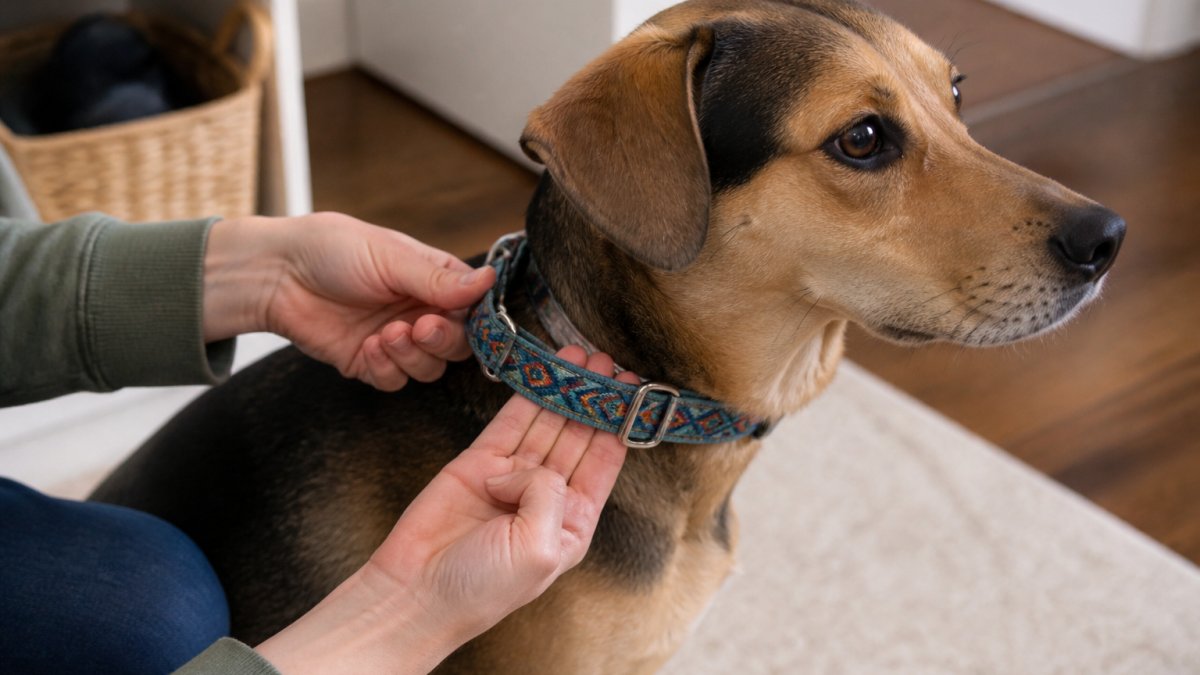
The two-finger test and other visual cues
The two-finger test is the fastest check. Slide two fingers flat under the collar at rest, they should pass with mild resistance.
The second check happens under tension.
A third cue: watch your dog's ears and eyes. A collar that's too tight under load shows up as head shaking, pawing at the neck, or a change in gait.
Safety Limits: Tracheal Pressure and Back-Out Prevention
Most guides treat the martingale's safety story as a single sentence: "it's safer than a choke chain." True, but that skips the mechanism, which determines whether the collar helps or hurts your dog.
What actually happens to the neck under load
The trachea is a tube of cartilage rings held open by soft tissue at the front of the neck, with the thyroid gland and recurrent laryngeal nerve alongside it. When a collar tightens, pressure concentrates on that front band.
Sustained or repeated pressure on the front of the neck can contribute to tracheal collapse, where cartilage rings weaken and the windpipe flattens during breathing.
Why the martingale's limit matters
The bounded tightening is the safety feature. A choke chain has no stop point; a martingale's control loop is sewn to a fixed length, so the larger loop can only close to a preset circumference, the limit that keeps it from cinching down on the trachea.
But the limit only protects your dog if the collar is sized correctly. An undersized martingale reaches its stop point while still pressing hard against the throat; a correctly sized one leaves a visible gap of roughly two fingers even when the metal loops meet.
Back-out prevention: the feature that earns the collar its place
Back-out is the failure mode a martingale solves. A flat collar sized for comfort is loose enough that a dog can pull backward, tuck its head, and slip free, an immediate danger near traffic, at a vet clinic, or on a busy sidewalk.
The martingale closes that gap: slightly loose at rest, tightening to its limit under backward tension. For dogs that panic at loud noises, have a history of slipping collars, or reverse direction unpredictably, this matters more than any training benefit.
When the safety math flips
Three conditions turn a safe collar into a risky one:
- Undersizing. No gap at the stop point means constant throat pressure.
- All-day wear. A martingale is walking gear. Left on in a crate or during unsupervised play, the control loop can snag on a fence, crate bar, or branch, and the tightening action becomes a strangulation hazard.
- Untrained pulling. The collar manages the walk, but a dog that never learns loose leash walking keeps loading the trachea on every step.
American Kennel Club resource on collar safety and fit
Which Dogs Benefit Most: Sighthounds, Escape Artists, and Pullers
Sighthounds are the classic case. Greyhounds, whippets, and salukis have narrow heads and thick necks, the exact shape that lets a flat collar slip off. A martingale is close to standard equipment for these breeds.
Pet dog collar with high quality soft comfort →
Escape artists come next. Any dog that has learned to reverse out of a collar, or that panics easily, benefits from the limited-slip design, including rescue dogs still adjusting to leash pressure.
Pullers are the trickier group. A martingale won't stop pulling, though it holds a pulling dog more securely than a flat collar. If your dog pulls hard, the better answer is usually a harness transition paired with training, a no-pull harness moves pressure off the neck entirely.
Shake Wag & Roll carries collar and leash sets built with soft cotton fabric and adjustable lengths, plus a no-pull harness and leash set for dogs that need pressure off the throat while they learn.

Best Dog Training Collars for Leash Pulling: What to Compare
The best collar for leash pulling depends on what you're trying to solve. Escape risk? A martingale wins. Pulling itself? A no-pull harness does more to change the behavior because it removes the neck pressure that reinforces pulling.
When you compare options, look at four things:
- Fit range: Does the collar adjust across your dog's full neck size?
- Material: Soft fabric or padded bands reduce chafing on daily walks.
- Hardware: A solid D-ring and sturdy buckle matter more than style.
- Purpose: Safety collar, training aid, or everyday walking gear?
A martingale is a safety mechanism. A harness is a walking aid. Many owners end up with both and switch based on the day.
For everyday walking, a soft comfort collar in polyester with a full size range works well for dogs that don't need a tightening mechanism. For evening walks, an LED adjustable collar adds visibility without changing the fit.

Common Mistakes and Long-Term Behavioral Dependency
The biggest long-term risk with martingales isn't physical. It's behavioral dependency, the collar becomes load-bearing for the walk itself. Owners who rely on the tightening action to control their dog never build the leash skills that make the collar unnecessary, and the walk stays a tug-of-war.
The more useful question is what dependency looks like, how to spot it, and how to phase the collar out.
What dependency looks like in practice
Dependency isn't a dog that wears a martingale. It's a dog whose behavior changes the moment the collar comes off. Three signals:
- The collar-off test. Swap to a flat collar for one walk. If pulling, lunging, or back-out attempts spike immediately, the dog has learned to behave for the collar, not for you.
- Tension-seeking. The dog drifts to the end of the leash and leans into the tightening action rather than responding to your cues. This is the opposite of loose leash walking.
- Handler reliance. You find yourself using the collar's tightening as a brake, a quick pop or a steady pull, instead of managing the walk through position, pace, and reward.
If any of those sound familiar, the collar is doing the training. That's the dependency pattern, and it's fixable.
The four mistakes that create it
- Leaving the collar on all day. It's walking gear. All-day wear blurs the line between "collar on" and "walk time," and creates a snag hazard in crates and yards.
- Sizing it tight at rest. A collar that's always applying pressure teaches the dog that tension is the baseline. The two-finger test at rest is non-negotiable.
- Skipping positive reinforcement. Treats, praise, and reward-based position work are what actually teach loose leash walking. The collar just keeps the dog attached while you do that work.
- Using it as a correction tool. The tightening action is a safety limit, not a signal. Dogs that receive leash corrections through a tightening collar can develop leash reactivity, barking, lunging, and freezing at the sight of other dogs, and that behavior is harder to undo than the original pulling.
How to transition off the martingale
The collar is worth it if you can eventually stop needing it. A phased transition:
- Confirm the behavior is fluent. Your dog walks on a loose leash for most of a 20-minute walk, on a flat collar, in a low-distraction environment.
- Introduce a flat collar for easy walks. Short, familiar routes first. Keep the martingale clipped to the leash as a backup if your dog has a back-out history, a double-ended leash or collar-to-collar connector lets you switch without stopping.
- Test in higher-distraction settings. Busy sidewalks, parks, and anywhere your dog has previously slipped or pulled. If the flat collar holds and the leash stays loose, you're ready.
- Keep the martingale for edge cases. Sighthounds, dogs with a genuine back-out history, and dogs in unfamiliar high-stress environments may always need the limited-slip design. That's a legitimate long-term use, not a training failure.
Owners who pair the collar with consistent reward-based training may find they need the tightening action less over time. The timeline depends on the dog, the trainer's consistency, and how much of the walk is spent in distraction-heavy environments.
Association of Professional Dog Trainers resource on loose leash walking
Verdict: Who Should Buy One, and Who Should Skip It
Buy a martingale if your dog has a narrow head, has slipped a flat collar, or panics on walks.
Skip it if your only problem is pulling. A no-pull harness plus a training plan will do more for your walks than any collar will.
The honest answer to whether a martingale collar is worth it for training: it's worth it for safety, and a poor substitute for training.
Frequently Asked Questions
What are the downsides of using a martingale collar?
The main downside is misuse. A martingale collar that's fitted too loose lets your dog back out of it, while one that's too tight applies constant pressure even when the leash is slack. It also isn't a substitute for teaching loose leash walking. If you rely on the tightening action every walk, your dog may never learn to walk calmly without that pressure. Use it as a management tool alongside positive reinforcement, not as the whole training plan.
Do vets recommend martingale collars?
Many veterinarians and trainers view martingale collars as a safer alternative to choke chains because the limited-slip design stops tightening at a set point. That said, no collar should sit tight all day, and dogs with existing tracheal or neck issues may do better in a harness. Ask your vet if your dog has a history of tracheal collapse, then pair the collar with a proper fit and short training sessions.
How does a martingale collar differ from a standard flat collar?
A flat collar has a fixed circumference, so a determined dog can slip it by backing out. A martingale collar adds a small loop of nylon webbing that tightens the collar when leash tension is applied, then loosens when the leash goes slack. This limited-slip action keeps the collar snug without the constant pressure of a choke chain, which makes it useful for sighthounds and dogs with narrow heads.
Can a martingale collar cause neck injury?
Any collar can cause injury if a dog hits the end of the leash hard or if the collar is fitted incorrectly. The martingale's advantage is that it stops tightening at a preset limit, unlike a choke chain. To reduce risk, keep the collar snug but not tight, avoid jerking the leash, and consider a no-pull harness for dogs that lunge. If your dog coughs or gags on walks, switch to a harness and check with your vet.
Is a martingale collar the best dog training collar for leash pulling?
It depends on why your dog pulls. For dogs that slip flat collars or have narrow heads, a martingale is a strong choice for control. For heavy pullers, a no-pull harness that distributes pressure across the chest is often more effective and easier on the neck. Many owners use both: a harness for walks and a martingale for training sessions that require precise control.
Every dog walks differently, and the right gear depends on your dog's shape, strength, and habits. Shake Wag & Roll carries adjustable collar and leash sets, no-pull harnesses, and durable walking accessories designed for daily use, backed by expert canine care tips and a community of owners who've been where you are. Get started with Shake Wag & Roll and find the walking setup that fits your dog.