

What Happens If a Dog Collar Is Too Tight?

Table of Contents
- What Happens If Your Dog's Collar Is Too Tight: The Immediate Risks
- How to Tell If a Dog Collar Is Too Tight
- The Two-Finger Rule for Dog Collars: How to Use It Correctly
- How to Adjust a Dog Collar for a Safe, Comfortable Fit
- Dog Collar Causing Hair Loss and Skin Irritation: What to Do
- What to Do Immediately After Finding a Too-Tight Collar
- When to See a Veterinarian for Collar-Related Injuries
- Frequently Asked Questions
Last Updated: October 7, 2026
What Happens If Your Dog's Collar Is Too Tight: The Immediate Risks
A dog collar too tight can restrict breathing, press on the windpipe, and damage skin within hours. At Shake Wag & Roll, we hear from owners every week who only notice the problem after their dog starts coughing or pulling away at the neck.

A dog collar that is too tight is a collar that presses on the airway, the veins, and the skin at the same time. That pressure builds up fast. It can cut airflow, slow blood flow to the head, and rub the coat down to bare skin.
Here is what happens, in order:
- Breathing gets harder. The windpipe narrows, so your dog pants more and tires quickly.
- Swallowing becomes painful. Pressure on the throat makes eating and drinking uncomfortable.
- Skin breaks down. Constant rubbing causes chafing, then infection.
- Escape risk rises. A collar that is too loose slips off just as easily as one that chokes.
The American Kennel Club guidance on collar safety makes the same point: fit is not a detail, it is the whole job.
How to Tell If a Dog Collar Is Too Tight
You can tell if a dog collar too tight by sliding two fingers flat under the band. If your fingers fit with a little room to spare, the fit is right. If you have to push, it is too tight.

Watch for these physical signs:
Physical Signs to Check Right Now
- Red or indented skin where the collar sits
- A visible ring-shaped groove in the coat
- Coughing, gagging, or a hoarse bark
- Pulling away when you reach for the collar
- Constant scratching or rubbing at the neck
- Damp fur from drooling or panting more than usual
- Hair thinning in a band around the neck
The Two-Finger Rule for Dog Collars: How to Use It Correctly
The two-finger rule for dog collars is a quick fit test: slide two flat fingers between the collar and your dog's neck. The band should sit snug but slide freely over your fingers. If it pinches your fingers, loosen the collar by one notch.
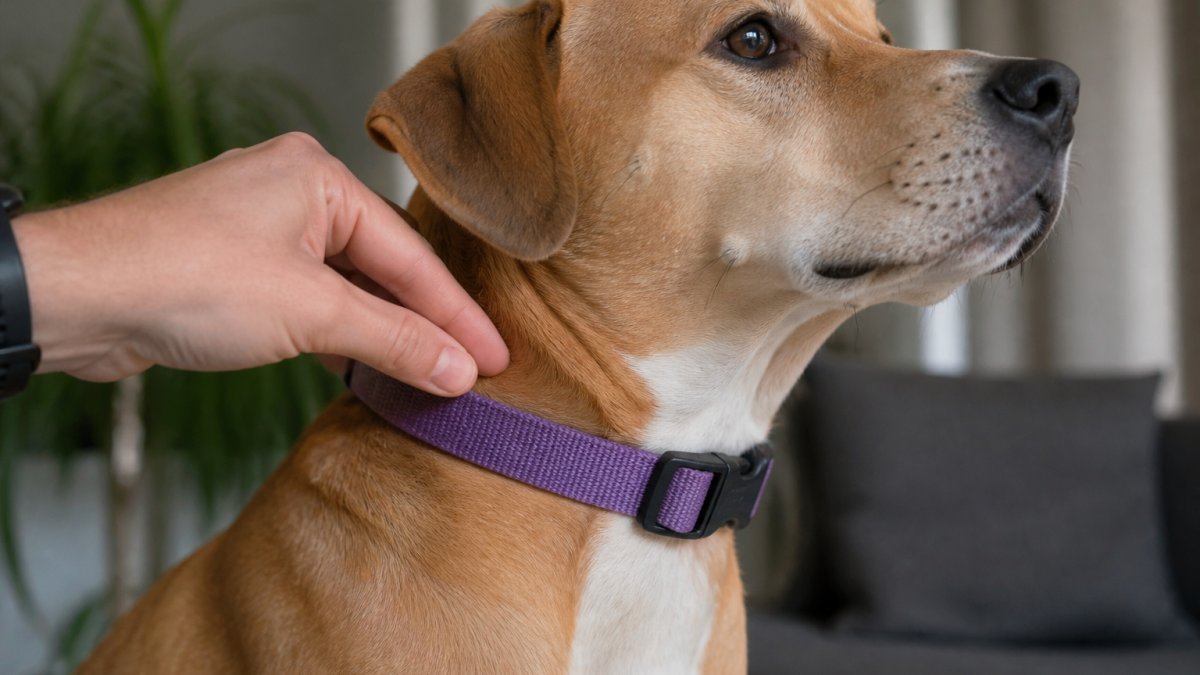
Here is how to run the test properly:
- Stand beside your dog, not in front. Dogs brace when they see a hand coming at their face.
- Slide two fingers flat under the band, side by side.
- Check at three points: the front of the throat, both sides, and the back of the neck.
- Slide the collar gently around the neck to confirm it moves without sticking.
The two-finger rule is a starting point, not a law. Short-coated breeds like boxers need a snugger fit than fluffy breeds like huskies, where fur hides the band. Puppies need more room because they grow fast.
How to Adjust a Dog Collar for a Safe, Comfortable Fit
Adjusting a dog collar takes about a minute, but the right adjustment depends on the collar type, your dog's neck shape, and where the band actually sits. Loosen or tighten one notch at a time, then recheck with the two-finger test after each change. Small steps beat big ones, because a single notch can change the fit by more than you expect.
Step-by-Step Adjustment
- Unclip the collar and lay it flat on a table.
- Find the adjustment point. On a traditional buckle collar, that is the prong and the nearest hole. On a plastic side-release buckle, it is the slider on the nylon strap. On a martingale, it is the limited-slip loop that tightens under tension.
- Move one notch in the direction you need. If the collar is too tight, go one hole or one slider position looser.
- Refit the collar and run the two-finger test at the throat, both sides, and the back of the neck.
- Check the D-ring. It should rest at the back of the neck, not under the throat, so a leash pull does not drag the band across the windpipe.
- Trim excess strap so it does not dangle and catch on fences, crates, or brush.
Measure Instead of Guessing
The two-finger rule is a quick check, but a tape measure removes the guesswork. Wrap a soft measuring tape around the middle of your dog's neck, snug but not tight, and add two fingers' width of slack. That number is your target collar size. Most manufacturers list a size range rather than a single number, so pick the range that puts your measurement in the middle, not at the edge. A collar sized at the very end of its range has no room to loosen if your dog's coat thickens or the neck swells.
Adjustment by Collar Type
- Flat nylon or leather buckle collar: Adjust at the holes or slider. These are the most forgiving for everyday wear, but a flat collar can still press on the trachea if it sits low on the neck.
- Martingale or limited-slip collar: These tighten only when the dog pulls. Adjust so the loop closes to roughly the width of your dog's neck plus two fingers, never tighter. A martingale that closes all the way down is a choking hazard, not a training tool.
- Head halter or no-pull harness: These do not go on the neck the same way, but the neck strap still needs a two-finger check. Many owners overtighten the neck strap trying to stop pulling and create the same pressure problem a tight collar causes.
- Harness alternative: For dogs with tracheal collapse, a history of neck injury, or short-nosed breeds, a well-fitted harness that crosses the chest instead of the throat removes the pressure point entirely.
Position Matters as Much as Tightness
A collar should sit high on the neck, just behind the ears, not down at the shoulders. High placement keeps the band from sliding over the windpipe when your dog pulls. If your dog's collar always drifts down to the shoulders, it is too loose, and the fix is a smaller size or a different style, not a tighter buckle.
A Quick Fit Schedule
Fit is not a one-time task. Check the two-finger test:
- Weekly for adult dogs with a stable weight.
- Every few days for puppies, who can outgrow a collar in a matter of weeks.
- After every grooming session, especially for double-coated breeds.
- After any weight change, illness, or medication that causes swelling.
- Before every walk if your dog is a strong puller, since a collar that shifts under load can tighten against the throat.
If you find yourself adjusting the same collar every week, the collar is the wrong size. Replace it rather than fighting the fit.
Dog Collar Causing Hair Loss and Skin Irritation: What to Do
A dog collar causing hair loss is usually a friction problem, not an allergy. The band rubs the same spot every day, and the coat wears away in a ring. Left alone, that bare patch can turn red, weep, and get infected.
Pet dog collar with high quality soft comfort →
What to do:
- Take the collar off for 24 to 48 hours.
- Clean the area with a damp cloth and mild pet-safe soap.
- Check the collar itself for rough edges, crusted dirt, or a bent buckle.
- Switch materials if the irritation keeps coming back.
- Rotate two collars so the pressure point moves.
Some dogs react to nickel in cheap hardware or to dye in low-quality fabric. If the skin is red, warm, or smells bad, that is past simple chafing. Call your vet.
Our pet dog collar with high quality soft comfort uses a soft polyester band with smooth edges, which cuts down on the rubbing that causes most coat damage. For dogs with sensitive skin, a wider band spreads pressure over more surface area than a thin one.
What to Do Immediately After Finding a Too-Tight Collar
Remove the collar right away, then check your dog's neck for marks, swelling, or broken skin. Do not wait to see if it "settles down." Pressure damage gets worse, not better, while the collar stays on.
Do this in order:
- Unclip or unbuckle the collar. Do not pull it over the head if the neck is swollen.
- Look at the neck in good light. Note redness, grooves, bald spots, or cuts.
- Feel gently for heat, lumps, or tenderness.
- Let your dog rest without a collar for a few hours.
- Clean minor irritation with a damp cloth.
- Refit or replace the collar before your next walk.
If your dog is coughing, wheezing, or struggling to breathe even after the collar is off, treat it as an emergency. Head to a vet clinic now.
When to See a Veterinarian for Collar-Related Injuries
Call your vet if the skin is broken, infected, or swollen, or if your dog shows any breathing changes after wearing a tight collar. Most mild chafing clears up at home. Deep grooves, open sores, and voice changes need a professional look.
Go to an emergency clinic if you see:
- Labored breathing or noisy breathing at rest
- Blue or pale gums
- Collapse, weakness, or confusion
- A deep cut or a wound that will not stop bleeding
- Swelling that presses on the throat
- Refusing food or water for more than a day
Long-term pressure can cause lasting damage. A collar worn too tight for months can scar the windpipe and leave the coat permanently thin in that band. The ASPCA pet care library notes that neck injuries in dogs are often linked to restraint gear that does not fit correctly.
How often should you check the fit? Once a week for adult dogs, and every few days for puppies. Growth, weight change, and grooming all shift the fit.
Your dog cannot tell you the collar is hurting. Our Dog Collar & Leash Sets use 100% soft cotton inside and out, with adjustable length and a solid zinc alloy D-ring for strength. Our Quick-Release Style Leather Collar and Leash Set gives you full-grain American leather and European steel for dogs who need something tougher.

Frequently Asked Questions
How do I tell if my dog's collar is too tight?
Slide two fingers flat between the collar and your dog's neck. If you can't fit two fingers, the collar is too tight. Other signs include red or raw skin under the collar, a visible indentation in the fur, coughing or gagging when the collar is touched, and your dog scratching at their neck. A collar that leaves marks after removal or causes your dog to pull away when you reach for it needs to be loosened immediately.
What problems can a too-tight dog collar cause?
A dog collar that is too tight restricts breathing by pressing on the trachea and airway. It can cause choking, gagging, and difficulty swallowing. Constant pressure leads to skin irritation, chafing, hair loss, and skin infections. Over time, a tight collar can damage the coat and cause neck soreness. The collar also becomes a strangulation risk if it catches on something.
Can a tight collar cause hair loss or skin irritation?
Yes. A dog collar causing hair loss is one of the most common signs of poor fit. Constant friction from a tight collar rubs the coat away, leaving bald patches around the neck. The trapped moisture and friction can also cause skin irritation, redness, and bacterial infections. If you notice thinning fur or raw skin under the collar, loosen the fit and give the area time to heal. Switch to a softer material like cotton or polyester and check the fit weekly.
How often should I check my dog's collar fit?
Check the fit every one to two weeks for adult dogs. Puppies need weekly checks because they grow quickly. Also check after grooming, weight changes, or seasonal coat growth. A collar that fit perfectly in winter may be too tight once your dog's summer coat comes in. Use the two-finger rule each time. If you can't fit two fingers under the collar, loosen it by one notch and recheck.