

What Makes Dog Collars Premium? Materials, Safety & Fit

Table of Contents
- What Actually Defines a Premium Dog Collar?
- Durable Dog Collar Materials: The Foundation of Quality
- Leather vs Nylon Dog Collars: Which Is Right for Your Dog?
- Hardware and Stitching: The Engineering Behind Premium Dog Collars
- Ergonomic Fit and Neck Health: Why Comfort Matters
- Dog Collar Safety Standards and Testing You Should Know
- Sustainability and Ethical Sourcing in Premium Collars
- Conclusion: Investing in Your Dog's Daily Comfort
- Frequently Asked Questions
Last Updated: September 6, 2026
What Actually Defines a Premium Dog Collar?
A premium dog collar is a piece of safety equipment engineered from high-grade materials with reinforced construction, not just a fashion accessory. When you ask what makes dog collars premium, the answer comes down to material integrity, hardware strength, and ergonomic design that protects your dog's neck during daily wear and sudden pulls. We evaluate collars against these same technical criteria because a collar that fails under pressure is a liability, regardless of how it looks.
Most owners discover the difference between a $20 collar and a $100 collar only after the cheap one breaks during a walk. The gap is not about branding but about tensile strength, corrosion resistance, and stitch count.
Below, we break down the materials, hardware standards, and fit principles that separate genuine quality from marketing claims, plus the safety testing and ethical sourcing factors behind the price.
Durable Dog Collar Materials: The Foundation of Quality
The single most important factor in what makes dog collars premium is the strap material. Durable dog collar materials determine how the collar handles daily stress, moisture, and the sudden force of a dog lunging toward a squirrel. Two categories dominate: leather and synthetic webbing, with leather offering distinct advantages for longevity and comfort.
Full-grain leather represents the top tier because it retains the natural fiber density of the hide, making it resistant to tearing and stretching. Vegetable-tanned full-grain leather also develops a patina over time, aging gracefully rather than cracking. Bonded leather, by contrast, is made from shredded leather fibers glued together and delaminates within months of regular use.
Full-Grain vs. Bonded Leather
Full-grain leather uses the entire thickness of the hide, preserving the dense fiber structure that gives the material its breaking strength. Bonded leather combines leather scraps with polyurethane, creating a product that looks acceptable in photos but lacks the structural integrity for load-bearing use.
A quick test: press your thumbnail into the surface. Full-grain leather will resist and show minimal indentation, while bonded leather will compress easily. The tactile quality difference is immediate, and it translates directly to how long the collar will last.
Leather vs Nylon Dog Collars: Which Is Right for Your Dog?
The choice between leather and nylon comes down to your dog's activity level and your tolerance for maintenance. Leather offers superior abrasion resistance and molds to the neck over time. Nylon webbing dries quickly and resists odor but can cause neck irritation if the edges are not finished properly.
For daily urban walks and casual wear, full-grain leather is the better choice because it distributes pressure evenly across the cervical spine area. For swimming, hiking in wet conditions, or heavy-duty training, a high-quality nylon collar with reinforced stitching may serve you better.
| Material | Strength | Weather Resistance | Comfort | Best For |
|---|---|---|---|---|
| Full-grain leather | High tensile strength | Moderate, needs conditioning | Molds to neck over time | Daily wear, urban walks |
| Bonded leather | Low, tears easily | Poor | Stiff, irritates | Avoid entirely |
| Nylon webbing | High, varies by weave | Excellent, dries fast | Can irritate if rough | Swimming, hiking, training |
Hardware and Stitching: The Engineering Behind Premium Dog Collars
A collar is only as strong as its weakest component, and that weakness is almost always the hardware or the stitching. While most articles stop at saying "use stainless steel," a truly premium collar is defined by the grade of that steel and the tested breaking strength of the entire assembly.
The Metallurgy of Hardware: Beyond "Stainless"
The term "stainless steel" covers a wide range of alloys. For a premium collar, you want 316 marine-grade stainless steel specified. The addition of molybdenum provides superior resistance to chlorides and saltwater, preventing pitting and corrosion over years of exposure. Cheaper collars often use zinc alloy or low-grade stainless that will rust after a few wet walks.
Solid brass is another premium choice, valued for its strength and natural corrosion resistance. However, the alloy matters. Look for naval brass (which contains tin) rather than standard yellow brass, as it is harder and more resistant to stress corrosion cracking in marine environments.
Tensile Strength: The Number That Matters
A vague promise of "heavy-duty" hardware is meaningless without a load rating. Premium manufacturers publish the breaking strength of their hardware, measured in pounds of force (lbf). A determined 70-pound dog can generate over 300 lbf in a sudden lunge, so a premium collar's D-ring and buckle should be rated to withstand a minimum of 500 lbf.
The Weld vs. The Crimp: A Structural Difference
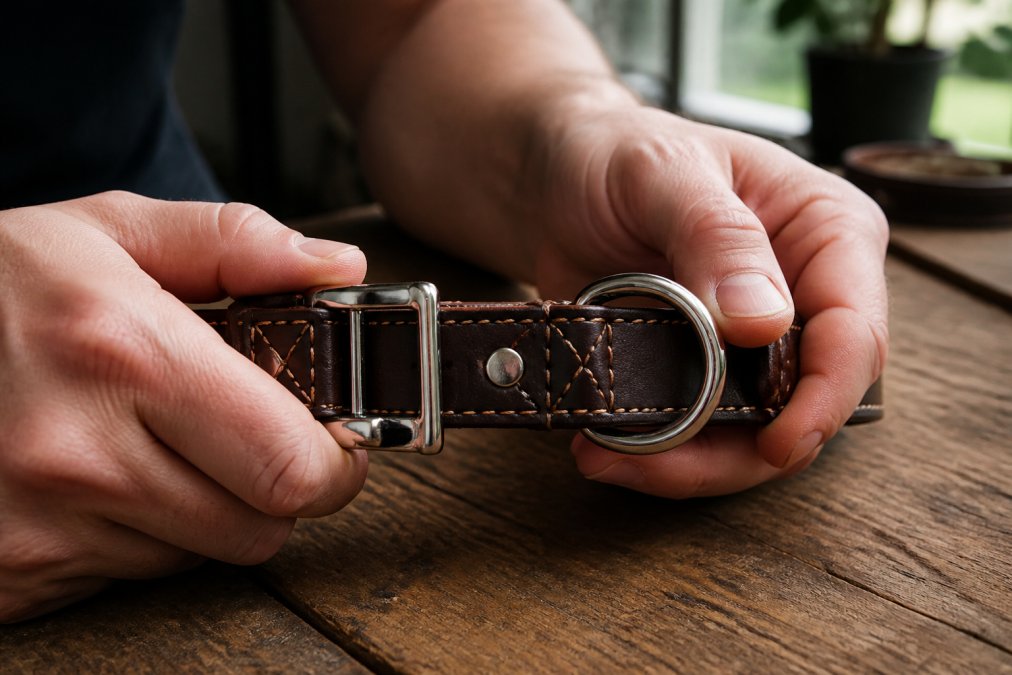
The D-ring is the primary attachment point for your leash. A welded D-ring is formed from a continuous piece of metal fused together, creating a seamless, solid loop. A crimped D-ring is bent into shape and held closed by a small metal sleeve. Under a sudden, high-force pull, a crimped ring can slip open, releasing the leash and your dog. The weld is the only acceptable construction for a premium collar.
Stitching as a Load-Bearing System
Reinforced stitching is the other half of the equation. Look for UV-stabilized, bonded nylon thread (often referred to as V-69 or V-92 in the industry). This is the same thread used in heavy-duty outdoor gear because it resists abrasion, mildew, and UV degradation, which causes ordinary polyester thread to become brittle and snap.
The stitch pattern is equally important. A standard straight stitch can unravel if broken at one point. Premium collars use a lock stitch or zigzag stitch with a high stitch count per inch (SPI), typically 8-10 SPI. More critically, the stress points, where the D-ring and buckle attach, must be bar-tacked. A bar-tack distributes the load across multiple stitches rather than a single point. This is the first place a cheap collar fails, and the last place a premium one will.

The Hardware Finish: A Functional Detail
Hardware finish matters beyond aesthetics. A smooth, polished finish prevents the D-ring from catching and abrading the leather or webbing during leash attachment. A rough, matte finish on cheap hardware acts like sandpaper, wearing down the strap material at the very point where stress is highest. Buckle security is critical: the prong should seat firmly into the hole without slipping, and the release mechanism should require deliberate pressure, not accidental contact.
Ergonomic Fit and Neck Health: Why Comfort Matters
The biomechanics of collar fit directly affect your dog's long-term health. The real issue is the biomechanical impact on the canine cervical spine. A collar transmits force from the leash to your dog's neck, and how that force is distributed determines whether a walk is comfortable or a source of chronic micro-trauma.
The Anatomy of the Canine Neck
The canine neck is a complex structure of seven cervical vertebrae, intervertebral discs, and a network of muscles. The trachea and larynx sit in the front of the neck, relatively unprotected by bone. A collar that sits too high, just behind the ears, presses directly against the larynx and the hyoid apparatus, a group of small bones that support the tongue. This position can cause coughing, gagging, and difficulty swallowing, especially when the dog pulls.
Pressure Distribution: The Case for Wider Collars
The fundamental principle of ergonomic collar design is force = pressure / area. A standard 1-inch collar on a 70-pound dog concentrates the force of a pull into a narrow band of tissue, creating high pressure points that can compress the superficial cervical nerves and restrict blood flow. A wider collar, typically 1.5 to 2 inches for medium and large breeds, spreads that same force over a larger surface area.
The Weight Factor: An Overlooked Variable
The weight of the collar itself is a critical ergonomic factor that is almost universally ignored. A heavy collar places a constant, low-grade load on the cervical spine. Over an 8-hour day, this static weight can cause muscle fatigue in the neck and shoulders. A premium collar balances material thickness with weight. For example, a 1.5-inch full-grain leather collar should weigh no more than 4 to 5 ounces. If a collar feels heavy in your hand, it will feel heavy on your dog's neck.
The Proper Fit: A Matter of Position and Tension
The biomechanics of fit go beyond the "two-finger rule." While that rule is a good starting point for tightness, the position of the collar is equally important. The collar should rest low on the neck, where the cervical spine is thicker and surrounded by more muscle mass, providing natural protection.
The "two-finger rule" also needs nuance. The two fingers should be inserted between the collar and the neck, and you should feel a snug but not tight fit. You should be able to rotate the collar freely around the neck, but it should not be so loose that it slips over the head. A collar that is too tight restricts breathing and can cause "collar pressure syndrome," which can lead to increased intraocular pressure and even glaucoma in predisposed breeds (PubMed).
Material Stiffness and Neck Movement
Finally, consider the material's stiffness. A stiff, newly manufactured leather collar can restrict natural neck movement, especially when the dog is sniffing the ground or looking up. This restriction can cause the dog to alter its gait to compensate, leading to muscle strain in the shoulders and upper back. A premium collar should be supple enough to conform to the neck's shape from the first wear.
Dog Collar Safety Standards and Testing You Should Know
Dog collar safety standards are not regulated by a single federal agency, so the burden falls on manufacturers to test their products honestly. Look for collars that publish their breaking strength test results. A reputable manufacturer will test the complete assembly, including the strap, stitching, and hardware.
The American Pet Products Association's safety resources offer guidance on what to look for in pet product safety. Additionally, the ASTM International's consumer product standards include voluntary standards for pet products that some premium manufacturers choose to follow. When a brand cites these standards, it signals a commitment to third-party verification rather than self-reported claims.
Durability testing should simulate real-world conditions: repeated pulling, exposure to moisture, and abrasion against rough surfaces. A collar that passes these tests will typically outlast three or four cheaper alternatives.
Sustainability and Ethical Sourcing in Premium Collars
The premium collar market has shifted toward transparency in sourcing. Vegetable-tanned leather uses natural tannins from tree bark rather than chromium-based chemicals, which reduces environmental impact and creates a safer product for your dog. Chromium tanning leaves residual chemicals that can cause skin reactions in sensitive dogs.
Ethical sourcing also extends to the leather itself. Premium manufacturers should be able to trace their hides to tanneries with certified environmental practices. This traceability adds cost, but it ensures the leather was produced without harmful chemicals and under reasonable labor conditions.
Hypoallergenic options exist, including collars made from natural fibers or high-quality synthetic materials that avoid the chemical residues found in some leathers. If your dog has shown signs of neck irritation or skin redness, consider a collar with a soft lining, such as corduroy or fleece.
Conclusion: Investing in Your Dog's Daily Comfort
Choosing a premium collar means prioritizing engineering over aesthetics, though the best collars deliver both. The materials, hardware, stitching, and fit principles we covered here are the same criteria we apply when selecting collars for dogs. A collar is worn every single day, often for hours at a time.
The Atlantis Collar from our collection exemplifies these standards with its genuine black leather base and hand-finished construction. For active dogs and training work, the Bestia Dog Sport Collar offers ultra heavy-duty hardware with a reinforced D-ring designed for maximum strength. Whichever you choose, look for the hallmarks we discussed: full-grain leather, welded hardware, reinforced stitching, and a fit that protects your dog's neck.

Sign up with Shake Wag & Roll to access expert canine care tips, exclusive offers on premium collars, and a community of owners who demand the same quality we do. Your dog wears this collar every day, so make it count.
Frequently Asked Questions
How can you tell if a dog collar is durable?
Check the material and construction. Look for full-grain leather or heavy-duty synthetic webbing, not bonded leather. Examine the stitching: high stitch count per inch indicates durability. Hardware should be stainless steel or marine-grade with solid welds on D-rings. The buckle should require deliberate force to release. A durable collar maintains its shape and strength after repeated pulling.
Are leather dog collars better than nylon?
It depends on your dog's lifestyle. Leather collars, especially full-grain, are naturally strong, mold to the dog's neck for comfort, and age well. Nylon collars are lightweight, dry fast, and are easier to clean, making them good for swimming or wet conditions. Premium leather lasts years, while high-quality nylon webbing offers weatherproof convenience. Consider your dog's activity level.
What safety features should a premium dog collar have?
Reflective stitching improves visibility. The D-ring must be welded, not bent, with high breaking strength. Ensure the collar fits snugly but allows two fingers between collar and neck to protect the trachea. Look for hardware that resists corrosion. The collar should not cause neck irritation.
Do premium dog collars provide more comfort for dogs?
Yes. Premium collars use materials like full-grain leather that soften and conform to your dog's neck shape. They feature smooth edges and linings that prevent chafing. Ergonomic designs distribute pressure evenly, especially important for dogs that pull. This reduces strain on the cervical spine. Cheaper collars often have rough edges and stiff materials that cause skin irritation.