

Why Do Dogs Need Mental Stimulation? A 2026 Guide

Table of Contents
- The Link Between Physical Exercise and Mental Stimulation
- Signs of Mental Exhaustion in Dogs
- Mental Stimulation Games for Dogs That Fit Any Schedule
- Interactive Dog Toys for Brain Health and Problem-Solving
- Why Mental Stimulation Matters for Every Dog
- How Mental Stimulation Reduces Separation Anxiety and Destructive Behavior
- Breed-Specific Mental Stimulation Needs
- Conclusion
- Frequently Asked Questions
Last Updated: September 27, 2026
The Link Between Physical Exercise and Mental Stimulation
A tired dog is not always a satisfied dog. A long walk burns energy but leaves the brain untouched. Mental stimulation is the deliberate use of problem-solving, scent, and training challenges to engage a dog's cognitive system, and it works alongside physical exertion rather than replacing it.
Physical exertion conditions the body; mental engagement conditions the mind. A dog that gets both settles faster, focuses better, and handles stress with more emotional balance. At Shake Wag & Roll, we hear the same story again and again: a dog that gets plenty of running but still chews the furniture.
Signs of Mental Exhaustion in Dogs
Most owners misread mental exhaustion as boredom, and that mistake leads to the wrong fix. Boredom means the dog needs more engagement; mental exhaustion means it has had enough and needs rest.
A bored dog is restless and actively seeking something to do: pacing, nudging, bringing toys, staring. A mentally tired dog may lie down but stay tense, or drift off and wake up wired.
- Snapping or growling during a game it normally enjoys. This is the clearest signal that the brain has had enough, not that the dog has become aggressive.
- Losing interest mid-puzzle. A dog that walks away from a treat toy it was solving five minutes ago is done, not stubborn.
- Zoomies after a training session. A burst of frantic energy right after focused work often means the session ran too long.
- Refusing food it normally works for. When a high-value treat stops motivating, fatigue has set in.
- Restlessness at night. A dog that cannot settle after a heavy enrichment day may be over-aroused rather than under-exercised.
How to tell when your dog is mentally tired, not just bored
Timing is the most reliable tool. Most dogs hit genuine mental fatigue after roughly 15 to 30 minutes of focused problem-solving, though high-drive breeds can go longer and seniors often need less. If your dog just finished a training session, snuffle mat, or puzzle feeder and is now pacing, the issue is usually arousal, not a lack of activity. Give it 10 to 15 minutes of quiet time before deciding it needs more.

Avoiding over-stimulation
More is not better. Piling enrichment on a mentally spent dog produces the same restless, destructive behavior owners are trying to fix. Rotate activities, cap sessions at a length your dog can handle, and build in rest days. A dog that works its brain hard three or four days a week often settles better than one that gets a puzzle daily.
Mental Stimulation Games for Dogs That Fit Any Schedule
You do not need an hour of free time to work your dog's brain. Mental stimulation games for dogs can take five minutes and still deliver real cognitive work. The key is variety, because a solved game stops being a challenge.
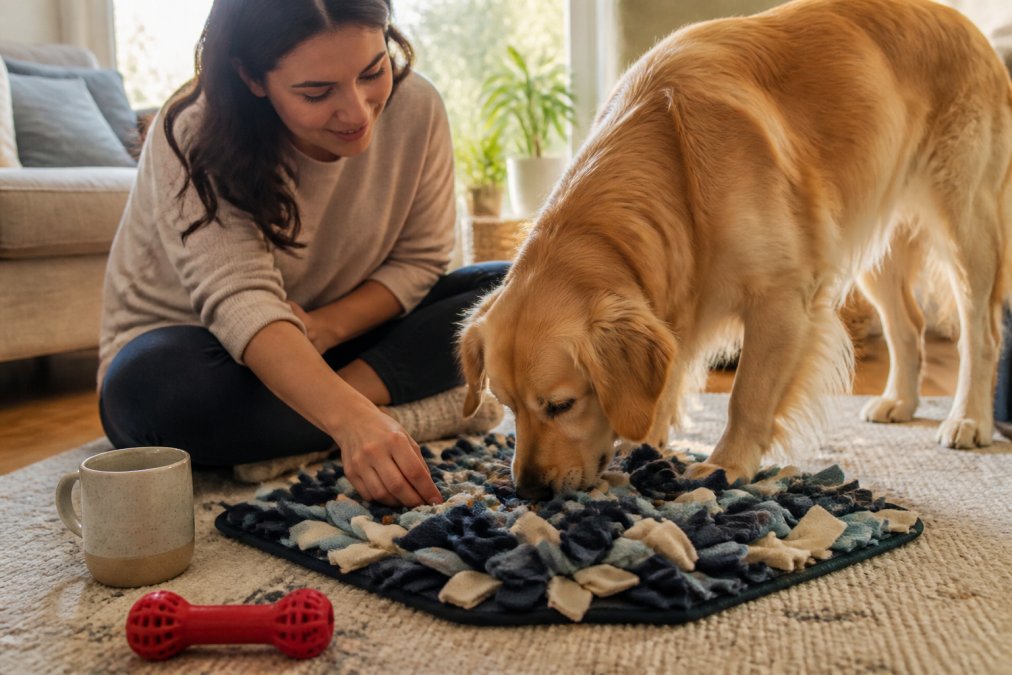
Five-minute options that work on busy days:
- Sniffari walks. Let your dog set the pace and sniff freely for ten minutes. Nose work is genuinely tiring because scent processing uses a large share of a dog's brain.
- Scatter feeding. Toss kibble across the lawn or a snuffle mat instead of using a bowl. Foraging turns mealtime into a puzzle.
- Cup game. Hide a treat under one of three cups and let your dog choose. This builds problem-solving and impulse control.
- Trick training. Teach one new cue in short bursts. Training sessions are mental exercise disguised as fun.
- Frozen treat puzzles. Freeze food into a toy so your dog has to work for it.
Interactive Dog Toys for Brain Health and Problem-Solving
Interactive dog toys for brain health do the work when you cannot be in the room. A puzzle feeder or treat-dispensing toy turns a few minutes of alone time into a problem-solving session.

Here is how the main categories compare:
| Toy Type | Best For | Mental Demand | Supervision |
|---|---|---|---|
| Snuffle mat | Foraging, slow feeding | Low to moderate | Minimal |
| Puzzle feeder | Problem-solving, impulse control | Moderate | Low |
| Treat-dispensing ball | Independent play | Moderate | Low |
| Recordable talking buttons | Communication, training | High | Required |
| Rolling smart ball | Active play, boredom relief | Moderate | Low |
Why Mental Stimulation Matters for Every Dog
Every dog benefits from mental stimulation, regardless of age, breed, or energy level. High-drive working breeds get most of the attention, but a senior lap dog with cognitive decline needs brain work just as much, sometimes more.
How Mental Stimulation Reduces Separation Anxiety and Destructive Behavior
Mental stimulation reduces separation anxiety and destructive behavior by giving a dog something to do with its attention before you leave. A dog that has already worked its brain is far more likely to sleep through your absence than one that has been staring at the door.
Pet Sniffing Pad Training Blanket →
Breed-Specific Mental Stimulation Needs
Breed matters more than most guides admit. A border collie and a bulldog can live in the same house and need completely different mental workloads. The fix is matching the type of mental work to the type of brain the dog was bred to use.
Herding breeds
Collies, shelties, Australian shepherds, and cattle dogs were developed to solve complex problems, read subtle movement cues, and make decisions independently. They need structured training, scent work, or a job, and they master puzzle toys quickly, so difficulty must keep increasing or the toy becomes furniture.
Terriers
Terriers were bred to hunt independently, which shows up as a strong drive to dig, chase, and investigate. They are less interested in pleasing a handler than in solving the problem themselves, so nose games and digging boxes suit them far better than repetitive fetch or obedience drills.
Working and sporting breeds
Retrievers, shepherds, spaniels, and pointers fall in the middle-to-high range. They do best with a mix of physical exertion and problem-solving, ideally a job that combines both. A retriever that gets a long swim but no thinking work will still chew; a shepherd that gets puzzles but no running will still pace.
Toy and companion breeds
Small companion breeds need less intensity but still benefit from daily training and foraging. The mistake is assuming a small dog needs no mental work: a bored toy breed can be just as destructive as a bored working breed, at a smaller scale.
Senior dogs and dogs with mobility limits
A senior dog with arthritis or a dog recovering from surgery cannot run, but its brain still needs work. Scent work is the highest-value option because it lets a dog work hard mentally while barely moving.
How much mental stimulation does a dog need each day?
Most dogs do well with two to three short sessions totaling 15 to 30 minutes daily, split between training, foraging, and interactive play. High-drive breeds may need closer to 45 minutes, while seniors with mobility issues do best with several brief, low-impact sessions.
Conclusion
The real challenge is not finding time for enrichment but building the habit before boredom turns into chewed baseboards and anxious departures. Start with one five-minute game a day and add a puzzle feeder to mealtime; that alone changes most households.
Frequently Asked Questions
How do I know if my dog is getting enough mental stimulation?
A mentally satisfied dog settles easily after play, sleeps soundly, and shows little interest in destructive chewing or pacing. If your dog constantly nudges you for attention, barks at nothing, or shreds furniture, those are common signs of boredom. Try adding two 10-minute brain games daily and watch for calmer behavior within a week. Puzzle feeders and snuffle mats are easy starting points.
What are the signs of mental exhaustion in dogs?
After a challenging puzzle or training session, a mentally tired dog may yawn, lie down with a sigh, lose interest in toys, or move more slowly. This is different from physical fatigue. Mental exhaustion often looks like a calm, content dog that stops soliciting play. If your dog seems wired instead of relaxed, the activity was too easy or too short. Adjust difficulty and duration to match your dog's energy.
Can mental stimulation help with dog anxiety?
Yes. Structured brain games give anxious dogs a job to do, which shifts focus away from triggers like loud noises or being alone. Scent work and puzzle feeders are especially helpful because sniffing lowers arousal. A 10-minute snuffle session can be as tiring as a 1-hour walk for some dogs. Pair mental games with a consistent routine for the best results with separation anxiety.
How much mental stimulation does a dog need daily?
Most dogs need 15 to 30 minutes of focused mental work each day, split into two or three short sessions. Puppies and high-drive breeds may need closer to 45 minutes. Senior dogs with mobility issues can benefit from 10 minutes of nose work or food puzzles. Rotate activities to prevent boredom. Interactive toys and training games make it easy to hit that target without a long walk.