

Are Probiotic Dog Treats Worth It for Digestion?

Table of Contents
- Are Probiotic Dog Treats Worth It for Digestion? The Honest Answer
- What Probiotics Actually Do for Gut Health
- Do Probiotics Help Dogs With Diarrhea and Other Digestive Upset?
- Treats vs. Powders, Capsules, and Veterinary Probiotics
- How to Read a Probiotic Dog Treat Label
- How Often to Give Dogs Probiotics (and When to Stop)
- Probiotic Dog Treats Side Effects and Safety Limits
- Vet-Recommended Probiotics for Dogs: What Vets Actually Look For
- A 30-Day Trial Plan to Test Whether Treats Are Worth It
- Frequently Asked Questions
Last Updated: October 8, 2026
Are Probiotic Dog Treats Worth It for Digestion? The Honest Answer
Probiotic dog treats are worth it for digestion if your dog has mild, occasional gut upset and you pick a product with the right strains and a real CFU count. They are not a cure for ongoing diarrhea or a diet problem.
Probiotics can help, and treats are the easiest way to give them, but the gap between a good chew and a useless one is wide.
What Probiotics Actually Do for Gut Health
Probiotics are live microorganisms that add to the mix of bacteria already living in your dog's gut. That mix, the gut microbiome, breaks down food, supports immunity, and keeps harmful bacteria in check.
Stress, diet changes, antibiotics, and travel tip that balance, and you often see it in the stool first.
Probiotics top up the good side of that balance, and some strains aid nutrient digestion.
They cannot replace a proper diet or treat a medical condition, for a sensitive stomach, a chew is support, not a fix.
What the Evidence Actually Supports, and What It Does Not
Most guides blur the line between veterinary research, what vets observe, and what owners report online. Treating all three as equal is how people end up disappointed.
Reasonably supported by veterinary evidence:
- Certain named strains can shorten mild, stress- or diet-related bouts of loose stool.
- Probiotics can support gut flora recovery after antibiotics, which is why vets commonly recommend them then.
- Some strains support the gut barrier and normal immune function.
Observed in practice but less firmly established:
- Improvements in gas, bloating, or stool consistency in dogs with sensitive stomachs.
- Skin and allergy benefits. The gut-skin link is real, but results vary widely by dog and strain.
Not supported, despite what marketing implies:
- That any probiotic treat will fix chronic diarrhea.
- That a higher CFU number is automatically better.
- That all probiotic products work the same way. Effects depend on the specific strain, the dose, and the dog's condition.
A useful rule: the more specific the claim, the more it should be tied to a named strain. "Supports digestive health" means anything; "contains [named strain] at a guaranteed count" is something you can evaluate.
Why Results Vary So Much Between Dogs
Two dogs on the same chew can have completely different outcomes. Three things drive that:
- Strain specificity. A strain studied for diarrhea may do little for gas. Matching strain to problem matters more than total CFU count.
- The dog's starting point. A dog with mild, occasional upset has more room to improve than one with an underlying condition a probiotic cannot address.
- Survival to the gut. A strain only helps if it survives stomach acid and reaches the intestine alive, which depends on the strain and how the product is stored.
A probiotic treat is a reasonable bet for mild, occasional upset, but not a reliable fix for a chronic or medical problem.
Do Probiotics Help Dogs With Diarrhea and Other Digestive Upset?
They can help with mild, short-term loose stools, but are much less useful for diarrhea lasting more than a day or two, or with vomiting, blood, or lethargy.
The typical pattern: a stressful event or food switch causes a few soft stools, and a probiotic shortens the rough patch. That is realistic.
Expecting a chew to stop diarrhea from a parasite, a foreign object, or a food allergy is not realistic. Those need a vet.
Signs Your Dog's Digestion Needs Support
Watch for these signals. One alone is normal; two or more together usually means the gut is struggling.
- Loose stools or diarrhea that comes and goes
- Gas that is worse than usual
- Bloating after meals
Skin symptoms surprise people, but the gut and skin are linked, and an unhappy gut often shows up as itching before diarrhea. A picky eater with soft stools deserves a closer look.
Treats vs. Powders, Capsules, and Veterinary Probiotics
Format matters more than most guides admit. Each trades convenience against dose accuracy and cost per effective dose, and effective dose answers whether a treat is worth it.
| Format | Best For | Main Drawback | Dose Control |
|---|---|---|---|
| Soft chews and treats | Picky eaters, daily use | Lower CFU counts, extra fillers and calories | Fixed per chew |
| Powders | Precise dosing, large dogs | Messy, some dogs refuse it | Adjustable by scoop |
| Capsules | High CFU counts, travel | Hard to hide in food | Fixed per capsule |
| Veterinary probiotics | Post-antibiotic recovery, illness | Needs a vet, costs more | Targeted, condition-specific |
Treats win on one thing: dogs actually eat them. A powder your dog refuses does nothing, however good the label looks.
The trade-off is dose: treats often carry fewer colony-forming units than capsules and add calories and fillers, which can matter as much as the bacteria for a sensitive stomach.
The Cost-Per-Day Math Most Guides Skip
This turns "worth it" from a feeling into a number. You need two figures: the label and the price tag.
- Find the CFU count per chew (not per bag).
- Find the price per chew (total price divided by the number of chews in the bag).
- Divide price per chew by the CFU count to get cost per billion CFU.
A bag that looks cheap per chew can be expensive per billion CFU if the count is low, and a pricey bag can be better value if each chew carries a guaranteed higher count.
Two more numbers to weigh:
- Cost per day. If your dog needs one chew daily, multiply price per chew by 30 for a monthly figure, then compare to a powder or capsule at the same dose.
- Waste factor. A refused powder or spit-out capsule is 100% wasted money; a chew that gets eaten is 100% delivered.
A common pattern: for a small dog on a maintenance dose, a quality chew is often the best value because the dose is small and the dog takes it willingly.
When a Treat Is the Right Tool, and When It Is Not
Treats are the right call for everyday digestive support in a healthy dog, for picky eaters, and for owners who want a routine the dog looks forward to, a real advantage, not a consolation prize.
Treats are the wrong tool when:
- Your dog needs a high, precise CFU dose that a fixed chew cannot deliver.
- Your dog is recovering from illness or antibiotics, where a targeted veterinary product is the appropriate choice.
- Your dog has food sensitivities and the chew's fillers, binders, or flavorings are a problem.
Veterinary probiotic products are made for digestive recovery after illness or antibiotics and usually carry higher, more targeted doses. For serious recovery, that is the right tool and worth the cost.
For everyday support, run the cost-per-day math on two or three chews before you buy. The cheapest bag and the best value are rarely the same product.
How to Read a Probiotic Dog Treat Label
Most labels are built to impress, not inform.
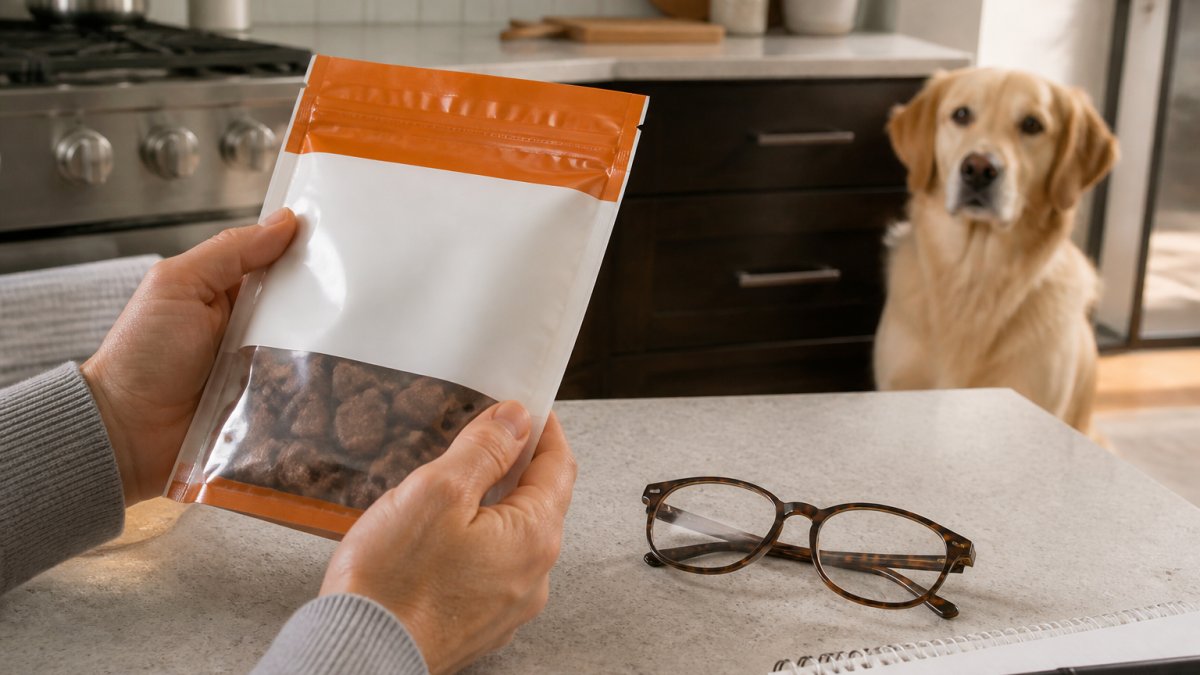
Start with the guaranteed analysis, not the front of the bag.
Then check the strain names. A quality label lists full strain names, not just "probiotic blend."
Finally, look at what else is in there. Limited ingredient formulas are easier on sensitive stomachs.
Use this checklist before you buy:
- Does the label state a CFU count per chew, not per bag?
- Is the CFU count guaranteed at the end of shelf life, not just at production?
- Are full strain names listed, not just "probiotic blend"?
If a bag fails two or more of these, put it back.
Strains, CFU Counts, and What the Numbers Mean
CFU stands for colony-forming units, and it measures how many live bacteria a dose contains. A higher number is not automatically better.
Look for named strains, like Lactobacillus and Bifidobacterium species, the ones most often studied for canine gut health.
Two numbers to compare:
- Dose per chew: the CFU count in one treat
- Shelf-life guarantee: whether that count holds until the "best by" date
A chew with a modest, guaranteed count beats a chew with a huge number that has already faded by the time you open the bag.
How Often to Give Dogs Probiotics (and When to Stop)
Daily use is the standard starting point for ongoing digestive support.
Consistency beats intensity. A steady daily dose does more than a big dose once a week.
Here is a simple schedule to follow:
- Days 1-3: Give the full dose once daily with food.
- Days 4-14: Keep the same dose. Watch the stool.
- Days 15-30: Continue if you are seeing improvement.
- After 30 days: Decide whether to keep going, pause, or switch.
When should you stop? If you see no change after a full month, stop.
You can also pause once symptoms settle. Some dogs do fine on a maintenance dose a few times a week; others need daily support long term.
Probiotic Dog Treats Side Effects and Safety Limits
Side effects are rare and usually mild: gas, a bit of bloating, or a soft stool in the first few days as the gut adjusts.
These usually settle within a week. If they do not, stop the chew.
A few real cautions:
- Weakened immune systems. Talk to your vet before giving live bacteria to a dog who is ill or on immune-suppressing drugs.
- Severe illness. Skip probiotics and call your vet if your dog is vomiting, has bloody diarrhea, or is very unwell.
- Allergies. Check the ingredient list if your dog has known food allergies.
Buy from brands that state their CFU counts honestly and use sealed packaging. A cheap chew with no strain names is a gamble, not a bargain.
Vet-Recommended Probiotics for Dogs: What Vets Actually Look For
Vets do not recommend a brand. They recommend a set of standards, and you match a product to them.
When we ask what matters, the same points come up again and again:
- Named strains with research behind them for dogs
- A guaranteed CFU count at the end of shelf life
- A species-appropriate formula, not a human one
Notice what is missing: fancy packaging and big claims. Vets care about what is inside and whether it survives to the gut.
The practical takeaway: if a treat lists its strains, guarantees its count, and keeps the ingredient list short, it is doing what vets look for.
For dogs recovering from antibiotic treatment, a vet may suggest a higher-dose veterinary probiotic instead of a chew.
A 30-Day Trial Plan to Test Whether Treats Are Worth It
You cannot know if a chew works for your dog until you test it properly.
Before you start:
- Pick one chew with named strains and a guaranteed CFU count
- Note your dog's current stool quality on a simple 1-5 scale
- Keep food and treats otherwise the same
Track it like this:
| Week | What to Do | What to Record |
|---|---|---|
| Week 1 | One dose daily with food | Stool score, gas, appetite |
| Week 2 | Same dose, no changes | Any shift in itching or paw licking |
| Week 3 | Same dose | Stool consistency trend |
| Week 4 | Same dose, then review | Compare to your starting score |
How to judge the result:
- Clear improvement: keep the chew as part of your routine.
- Some improvement: extend to 60 days before deciding.
- No change: stop. The chew is not the answer for your dog.
One rule makes this work: change only one thing at a time.
This is the part most owners skip, and it is why so many end up guessing.
Our limited ingredient options keep the extras out, so a sensitive stomach has less to react to.
Frequently Asked Questions
Do probiotic chews really work for dogs?
They can help, but results depend on the product. A chew only works if it delivers a tested strain at a meaningful CFU count and survives storage. Many soft chews lose live bacteria over time, especially in warm conditions. Look for a guaranteed CFU count at the end of shelf life, not just at time of manufacture, and expect gradual changes over two to four weeks rather than overnight results.
How often should you give your dog a probiotic chew?
Most dog owners give one chew daily, ideally at the same time each day, since consistent dosing helps beneficial bacteria establish in the gut. During or after antibiotic treatment, some vets suggest splitting the dose between morning and evening. Always separate probiotics from antibiotics by at least two hours, because antibiotics can kill the bacteria you are trying to add.
Can probiotic dog treats cause side effects?
Mild gas, softer stools, or slight stomach upset can appear in the first few days as the gut adjusts. These usually settle within a week. Stop the treat and call your vet if you see vomiting, bloody diarrhea, lethargy, or itching that worsens. Dogs with weakened immune systems or serious illness should only start probiotics under veterinary guidance.
How long does it take for probiotics to help a dog's digestion?
Many owners notice firmer stools and less gas within one to two weeks of daily use. Full effects on stool quality and nutrient absorption often take three to four weeks. If diarrhea persists beyond 48 hours, or your dog shows blood in the stool, repeated vomiting, or weight loss, skip the treats and get a veterinary exam instead.
Sorting out your dog's digestion takes patience, and the wrong chew just adds another month of guessing. Shake Wag & Roll can take some of that weight off. We stock limited ingredient treats and organic chews built for sensitive stomachs, plus expert canine care tips to help you read a label with confidence. Sign up with Shake Wag & Roll and find treats your dog will actually eat, backed by a community of owners who have been exactly where you are.