

How to Measure for a Dog Harness Correctly

Table of Contents
- Why Accurate Measurements Matter for Your Dog's Comfort
- Tools You Need to Measure Your Dog
- How to Measure for a Dog Harness Correctly: Step-by-Step
- How to Read a Dog Harness Sizing Chart
- How to Fit a Dog Harness: The Two-Finger Rule
- Signs a Dog Harness Is Too Tight (and What to Do)
- Measuring Dogs With Thick Fur and Breed-Specific Tips
- Frequently Asked Questions
Last Updated: September 19, 2026
Why Accurate Measurements Matter for Your Dog's Comfort
A harness that fits poorly rubs the same spot on every walk. That friction causes chafing, hair loss, and a dog that plants its feet at the door. Learning how to measure for a dog harness correctly takes about five minutes and prevents weeks of discomfort.
Here is what we will cover:
- The one tool you actually need
- Three measurements that decide the size
- How to read any sizing chart
- How to check the fit in ten seconds
Tools You Need to Measure Your Dog
The best tool for measuring a dog is a soft measuring tape, the kind used for sewing. It bends around the body and gives a true reading.
Gather these before you start:
- Soft measuring tape or string plus a ruler
- A few treats to keep your dog still
- A helper if your dog wiggles
- The sizing chart for the harness you plan to buy
How to Measure for a Dog Harness Correctly: Step-by-Step
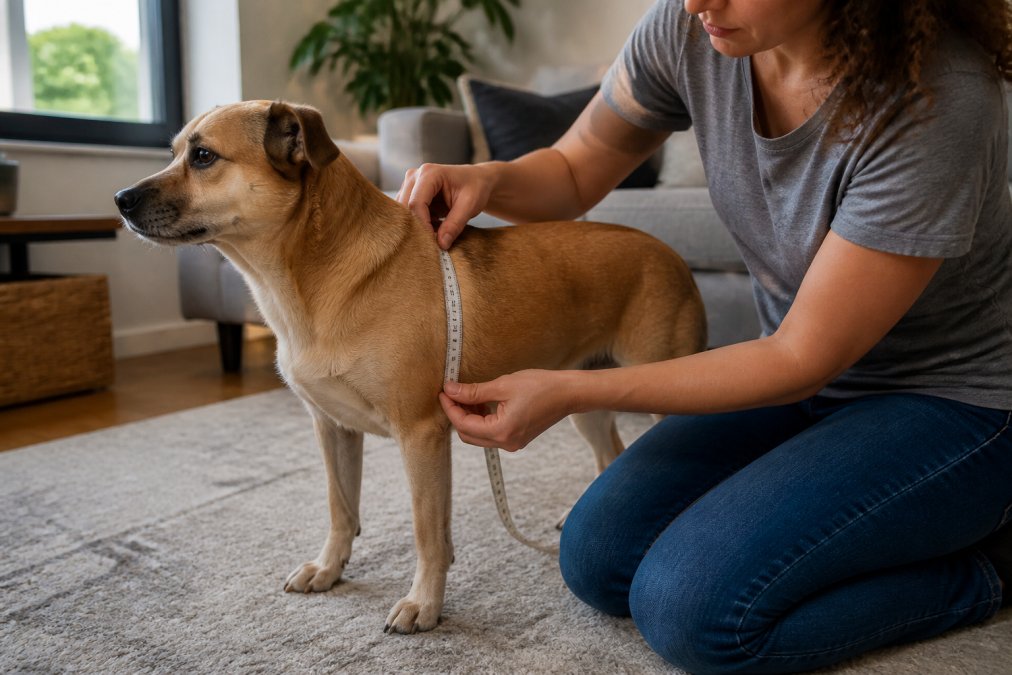
The process has three steps. Measure the neck first, then the chest, then the back. Write each number down as you go.
Step 1: Measure the Neck
Wrap the tape around the base of the neck, where the neck meets the shoulders. This is lower than where a collar sits.
Step 2: Measure the Chest (Girth)
Find the widest part of the chest. On most dogs, this sits just behind the front legs.
Step 3: Measure the Back Length
Start at the base of the neck, between the shoulder blades. Run the tape along the spine to the base of the tail.
How to Read a Dog Harness Sizing Chart
A dog harness sizing chart lists sizes by chest girth, usually in inches. Find your dog's girth number, then pick the size range it falls inside. That sounds simple until your number lands on a boundary or your neck and girth readings disagree. Here is how to resolve both.
Most charts look like this:
| Size | Chest Girth | Neck Range | Typical Weight |
|---|---|---|---|
| XS | 12-16 in | 9-11 in | 5-10 lb |
| S | 16-20 in | 11-13 in | 10-20 lb |
| M | 20-26 in | 13-17 in | 20-40 lb |
| L | 26-32 in | 17-21 in | 40-65 lb |
| XL | 32-40 in | 21-26 in | 65-90 lb |
What to Do When Your Dog Falls Between Two Sizes
This is the single most common reason owners buy two or three harnesses before finding one that works. The fix depends on which measurement is off:
- Girth lands on a boundary (say, exactly 26 in between M and L). Size up. Adjustable straps can take up slack, but they cannot add length. A harness that is one notch too loose is safe; one that is one notch too tight is not.
- Girth fits one size but neck fits the size below. Trust the girth. Neck straps on most harnesses have a wider adjustment range than chest straps, so a slightly large neck opening is easier to cinch down than a too-small chest panel.
- Girth fits one size but neck fits the size above. This is the harder case. A dog with a thick neck and narrow chest, common in some terriers and sighthound mixes, often needs a harness with independent neck and chest adjustment rather than a single-size vest. Look for a style that lists separate neck and girth ranges instead of one combined number.
- Weight says one size, girth says another. Always follow girth. Weight ranges are a rough average across all breeds; a lean, deep-chested dog and a stocky, barrel-chested dog of the same weight can wear two different sizes.
Reading the Chart Like a Fit Spec, Not a Label
- Check whether the ranges overlap. Good charts overlap by an inch or two (for example, M ends at 26 in and L starts at 25 in) so boundary dogs have a home. Charts with hard cutoffs and no overlap are harder to fit.
- Look for a measurement point diagram. The chart should show where the girth is taken, behind the front legs, at the widest part of the ribcage. If it does not, assume the standard girth point and measure there.
- Note the adjustment range, not just the size range. A harness listed as "M: 20-26 in" with two inches of strap adjustment only truly fits dogs from about 20 to 24 in comfortably. The stated range is the outer limit, not the sweet spot.
Weight conversion charts help as a rough check, but they are a backup, not the main decision. The girth number is the one that decides the size.
Pet Harness And Leash Set For Dog & →
How to Fit a Dog Harness: The Two-Finger Rule
The two-finger rule is the fastest fit check there is. Slide two fingers flat under each strap. If they fit, the harness is snug but not tight.
Test these spots:
- Under each adjustable strap
- Across the chest plate
- Behind the front legs
Signs a Dog Harness Is Too Tight (and What to Do)
Knowing the signs a dog harness is too tight saves your dog from daily discomfort. Check for these signals after every walk:
- Red marks or rubbed fur where straps sit
- Hair thinning along the chest or armpits
- A dog that stops mid-walk or scratches at the harness
- Chafing, scabs, or hot spots under the straps
- Stiff, shortened strides
Measuring Dogs With Thick Fur and Breed-Specific Tips
Thick coats change the math. A double-coated breed can measure two sizes larger than its body, because the tape rides on top of the fur. The goal is to measure the dog, not the coat, but you also cannot compress the coat, because that gives a reading that is too small and a harness that rubs.
How to Measure a Dog With a Thick or Double Coat
Use this sequence for any dog with a heavy undercoat, a curly coat, or a winter coat that has not blown yet:
- Comb the coat down flat along the chest and ribcage first. Parted or standing fur adds phantom inches.
- Lay the tape on the coat and press gently until it contacts the body underneath, you should feel the ribs, not squish them. Do not pull tight.
- Take the reading twice, once at the widest point behind the front legs and once an inch forward. If the two numbers differ by more than an inch, you are catching fur unevenly; smooth the coat and repeat.
- Round up, not down. If your girth reads 24.5 in on a fluffy dog, treat it as 25 in. Fur compresses under a strap, so a snug-on-the-coat measurement becomes a tight-on-the-body fit after a few minutes of walking.
Breed Shape Changes Where You Put the Tape
Breed shape matters as much as size, and it changes the measurement point, not just the number:
- Deep-chested breeds (Greyhounds, Whippets, Boxers, Dobermans) have a chest that drops well below the elbow and narrows sharply behind the ribcage. Measure at the deepest part of the chest, then measure again at the narrowest point behind the ribs. If those two numbers differ by more than about three inches, a standard vest will gap at the narrow point and rub at the deep point. Look for a harness with a longer chest panel and a third adjustment strap.
- Barrel-chested breeds (Bulldogs, French Bulldogs, Pugs, Boston Terriers) are wide and shallow. The widest point sits further forward than on most dogs, often right behind the front legs rather than mid-ribcage. Measure there, and expect the neck and girth numbers to be close together, a sign you need a harness with a wide chest plate rather than a long body panel.
- Narrow-chested breeds (Whippets, Italian Greyhounds, Salukis) can slip out of standard harnesses even when the girth fits. The issue is the neck opening, not the chest. Look for a style with a snug neck opening or a third belly strap, and measure the neck at its narrowest point, not the base.
- Small breeds (Chihuahuas, Yorkies, Dachshunds) need lighter hardware so the harness does not weigh them down, and their girth is often smaller than the smallest chart size. Measure carefully, a half-inch error is a full size at this scale.
- Long-backed breeds (Dachshunds, Corgis, Basset Hounds) need the back-length measurement to matter more than it does for other dogs. A vest that is too short will ride up; one that is too long will bunch at the tail. Measure from the base of the neck to the base of the tail and check that number against the harness's body length, not just its girth.
Harness Type Changes the Measurement Priority
Different harness styles use your numbers differently, so weigh them accordingly:
- Back-clip harnesses rely almost entirely on the girth measurement. Neck and back length are secondary.
- Front-clip and no-pull harnesses need an accurate girth plus a snug chest fit, because the leash pressure pulls across the chest. A loose chest panel on a front-clip harness will twist.
- Step-in harnesses depend on girth and the distance between the front legs. Measure that gap too, from the inside of one front leg to the inside of the other, if the chart asks for it.
- Vest and tactical harnesses use all three measurements, because the body panel has to sit flat along the spine without pulling at the shoulders.
Frequently Asked Questions
How do I know what size dog harness I need?
Measure your dog's chest girth at the widest point behind the front legs, then compare that number to the brand's dog harness sizing chart. Chest girth is the most reliable measurement because it determines whether the harness will fit around the body. Neck and back length help narrow the choice, but girth is the deciding factor for most adjustable harnesses.
Should I measure my dog's neck or chest for a harness?
Measure both, but the chest girth is the primary measurement for harness sizing. The neck measurement matters for step-in or overhead harnesses, while chest girth determines the main body fit. For no-pull or vest-style harnesses, chest girth carries the most weight on the sizing chart. Always measure the widest part of the chest, right behind the front legs.
How many fingers should fit under a dog harness?
The two-finger rule is the standard test: you should be able to slide two fingers flat under any strap of the harness. If you can only fit one finger, the harness is too tight and may cause chafing. If you can fit three or more fingers easily, it is too loose and your dog could slip out. Check the neck, chest, and belly straps individually.
What if my dog is between sizes on the sizing chart?
Size up when your dog falls between two sizes, especially if they are still growing or have thick fur. A harness that is slightly too large can be tightened with adjustable straps, but one that is too small will restrict range of motion and cause discomfort. Check the brand's return policy before ordering so you can exchange if the fit is not right.