

Best Healthy Dog Treats for Small Dogs in 2026

Table of Contents
- Best Healthy Dog Treats for Small Dogs: Quick Comparison
- How to Choose Healthy Dog Treats for Small Breeds
- Best Limited Ingredient Dog Treats for Sensitive Small Dogs
- Low Calorie Training Treats for Small Dogs
- Treat-to-Meal Ratio: How Many Treats Your Small Dog Actually Needs
- Freeze-Dried vs. Baked: Which Healthy Dog Treats Suit Small Dogs Best?
- Frequently Asked Questions
Last Updated: October 3, 2026
Best Healthy Dog Treats for Small Dogs: Quick Comparison
Small dogs burn fewer calories than large ones, so the best healthy dog treats for small dogs are low-calorie, bite-sized, and made from recognizable ingredients. A 10-pound dog needs roughly 200 to 275 calories a day, which means a single oversized biscuit can eat up a tenth of that budget in one bite. At Shake Wag & Roll, we built this guide around that math because most treat roundups ignore it entirely.
Below, we compare four treats we actually carry, explain how to choose healthy dog treats for small breeds, and show you the treat-to-meal ratio that keeps weight in check.
Quick Picks:
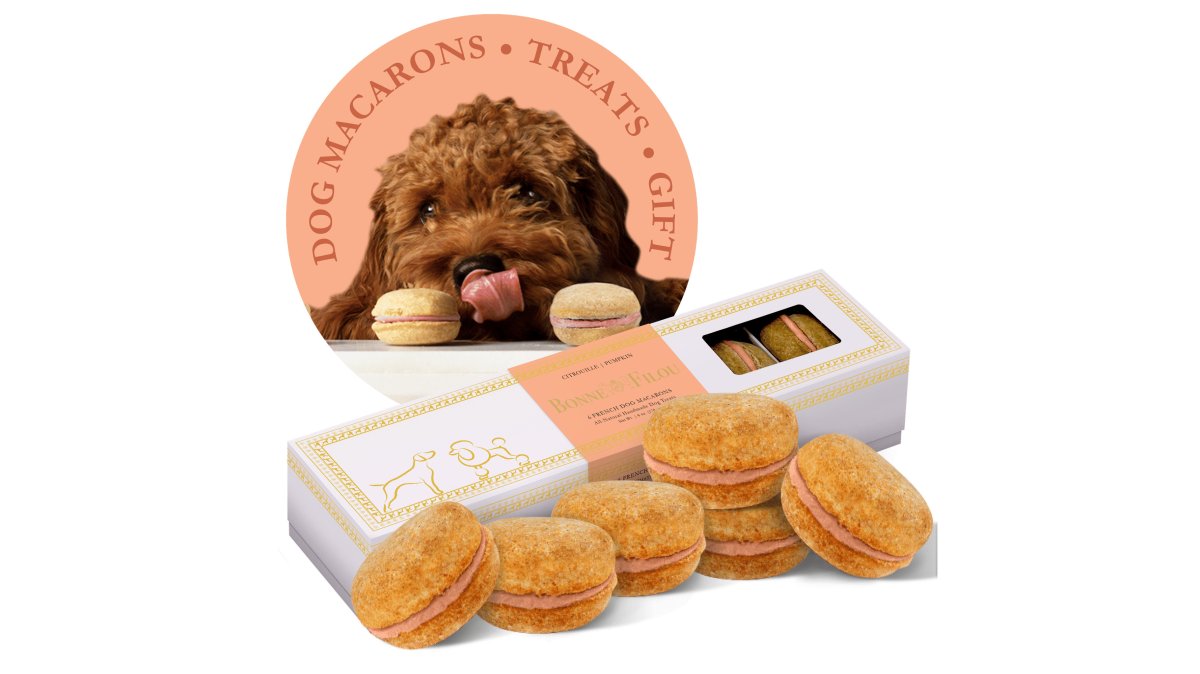
- Best Overall: Dog Macarons (Bonne et Filou), human-grade, wheat-free, and easy to break into small pieces
- Best for Sensitive Stomachs: Cookie Pal Pumpkin Chia, 95%+ organic and gluten-free
- Best Low-Calorie Training Treat: Bixbi Trainer Treats Bacon, about 3.9 calories per treat
- Best Simple Recipe: Portland Pet Food Company Pumpkin Biscuit, five ingredients, nothing else
| Treat | Key Ingredients | Calories | Best For | Price |
|---|---|---|---|---|
| Dog Macarons (Bonne et Filou) | Oat flour, honey, coconut oil, yogurt filling | Not listed | Long-lasting chew, gifts | $25.42 for 6 |
| Cookie Pal Pumpkin Chia | Organic lentils, pumpkin, chia seeds | Not listed | Sensitive stomachs | $41.81 for 4 x 10 oz |
| Bixbi Trainer Treats Bacon | Pork, chickpea flour, bacon | About 3.9 per treat | Training sessions | $60.81 for 8 x 6 oz |
| Portland Pet Food Pumpkin Biscuit | Garbanzo bean flour, pumpkin, peanut butter | Not listed | Simple ingredient lists | $57.86 for 6 x 5 oz |
How to Choose Healthy Dog Treats for Small Breeds
Start with calories per treat, not the front of the bag. Small breeds have faster metabolic rates per pound than large dogs, so portion control matters more for them than for almost any other group. A treat that is a rounding error for a Labrador can be a real meal for a Chihuahua.

Three things decide whether a treat fits your dog:
- Caloric density: How many calories sit in one piece, and how many pieces you hand out daily
- Protein source: Named meats beat vague "meat meal" or by-products every time
- Digestibility: Simple recipes with fewer ingredients are easier on small digestive systems
The FDA guidance on pet food labels is a useful reference here, since treat packaging rules differ from complete-and-balanced food rules.
Caloric Density and Treat-to-Meal Ratios
Treats should make up no more than 10 percent of your dog's daily calories. That is the widely used benchmark in veterinary nutrition, and it matters most for toy breeds. For a 10-pound dog eating about 250 calories a day, that leaves roughly 25 calories for treats. Two Bixbi Trainer Treats at about 3.9 calories each use a third of that budget.
Ingredients to Avoid in Small Dog Treats
Skip artificial fillers, unnamed by-products, and heavy syrups when you can. Small dogs eat so little that every ingredient counts, and a treat loaded with fillers delivers volume without nutrition. Look instead for single-ingredient or short-list recipes, natural preservatives like mixed tocopherols and rosemary extract, and a named protein source up front.
Best Limited Ingredient Dog Treats for Sensitive Small Dogs
Limited ingredient treats win for dogs with allergies or touchy digestion because there is less to react to. Two of our picks fit that brief, and both keep the recipe short enough to scan in seconds.
Cookie Pal Pumpkin Chia is 95%+ organic, gluten-free, GMO-free, and wheat-free. The recipe runs on organic ground lentils, sprouted buckwheat flour, pumpkin, chia seeds, cinnamon, and ginger, a combination that leans on gentle, recognizable plants rather than synthetic additives.

Portland Pet Food Company Pumpkin Biscuit goes even shorter: garbanzo bean flour, pumpkin, peanut butter, molasses, and cinnamon. Five ingredients, made in the United States, and nothing you cannot pronounce.
For dogs with confirmed protein allergies, a single-ingredient or novel-protein treat is the safest starting point. Introduce one new treat at a time and watch for changes over a few days before adding another.
Low Calorie Training Treats for Small Dogs
Training treats need two qualities: low calories and high palatability. You will hand out a lot of them in a single session, so a treat that costs 30 calories each turns a five-minute training block into a meal replacement.
Bixbi Trainer Treats Bacon are built for exactly this. Each treat runs about 3.9 calories, the recipe is grain-free and wheat-free, and the soft texture makes them easy to break in half for even smaller rewards. A small dog can earn ten of these in a session for under 40 calories, which fits comfortably inside the 10 percent rule.
Treat-to-Meal Ratio: How Many Treats Your Small Dog Actually Needs
Most roundups stop at "keep treats under 10 percent of daily calories" and leave you to guess what that means for a 6-pound Yorkie versus a 20-pound Cocker Spaniel.
Here is the working formula we use, built around resting energy requirements (RER), the standard veterinary calculation for baseline calories:
RER = 70 x (body weight in kg)^0.75
Then multiply RER by a life-stage factor. Most practitioners use roughly 1.6 for a neutered adult, 1.8 for an intact adult, 2.0 for a lightly active dog, and 3.0 for a puppy under four months. That gives you maintenance calories (MER). Treats should stay at or under 10 percent of MER.
Run the numbers for three sizes:
Dog Macarons - Count of 6 (Dog Treats | Dog Gifts) →
| Dog weight | Approx. MER (neutered adult) | 10% treat ceiling | Treats at ~3.9 cal each |
|---|---|---|---|
| 5 lb (toy) | ~180 cal | ~18 cal | 4 treats |
| 10 lb (small) | ~250 cal | ~25 cal | 6 treats |
| 20 lb (small-medium) | ~420 cal | ~42 cal | 10 treats |
Two things jump out. First, a 5-pound dog has a treat budget of about four training treats per day, not per session. Second, the jump from 5 to 20 pounds quadruples the treat allowance, which is why treating "small dogs" as one category produces bad advice.
Toy breeds also carry a higher metabolic rate per pound than larger dogs, so they burn through a treat faster and feel hunger sooner. That cuts both ways: they tolerate frequent tiny rewards well, but a single 40-calorie biscuit can blow the entire day's budget.
A few practical adjustments:
- Training days: If you plan a 15-minute session, pre-count the treats. Ten Bixbi Trainer Treats at ~3.9 cal each is ~39 cal, which already exceeds a 5-pound dog's daily ceiling. Break each treat in half and you get 20 rewards for the same calories.
- High-value rewards: Reserve the calorie-dense items (a broken Dog Macaron, a piece of baked biscuit) for one or two reps per session, not the whole block.
- Puppies: Growing puppies need more calories per pound, so the 10 percent ceiling scales up, but so does the risk of over-treating during house training. Use a portion of the daily kibble as the reward instead of adding treats on top.
- Seniors: Slower metabolisms mean a lower MER. Recalculate every 6 to 12 months, or after any weight change of more than 5 percent.
If you would rather not do the math, ask your veterinarian to set a daily calorie target and a treat ceiling in the same visit. Bring the treat bag so they can read the calorie-per-treat line with you.
Freeze-Dried vs. Baked: Which Healthy Dog Treats Suit Small Dogs Best?
Most comparisons of freeze-dried and baked treats stop at texture.
How the two methods differ
Freeze-drying removes water by sublimation, the product is frozen, then the ice is pulled off under vacuum without ever passing through a liquid phase. That preserves raw proteins, enzymes, and aroma almost intact, and leaves a very light, porous piece.
Baking drives water off with heat. The result is denser, firmer, and shelf-stable at room temperature. Baked biscuits typically hold their shape in a pocket or treat pouch, and they tend to be more uniform in size, which makes calorie counting easier if the manufacturer prints a per-piece number.
What that means for a small dog
| Factor | Freeze-Dried | Baked |
|---|---|---|
| Texture | Light, crumbly, easy to snap | Firm, holds shape |
| Calorie density | High per ounce, low per piece | Moderate, varies by recipe |
| Portion control | Easy to crumble, hard to halve cleanly | Easy to snap along a score line |
| Choking risk | Low, softens fast in saliva | Higher for hard biscuits in toy breeds |
| Best use | High-value rewards, training | Long-lasting chews, crating |
For toy breeds, the deciding factor is usually breakability, not the drying method. A freeze-dried nib that crumbles into three pieces gives you three rewards for the calorie cost of one.
Where each fits in our picks
The Dog Macarons are a baked-style chew, firm enough to last, which is why the listing itself advises twisting them apart for small or elderly dogs. The Cookie Pal Pumpkin Chia and Portland Pet Food Pumpkin Biscuit are baked but softer, so they snap cleanly.

The short version: choose freeze-dried when you want a high-value reward you can crumble into multiple pieces, and choose baked when you want a durable, countable treat for crating or a long chew. Match the format to the job, not to a brand claim.
Frequently Asked Questions
How many treats should a small dog have per day?
Treats should make up no more than 10% of a small dog's daily calories. For a 10-pound dog eating about 300 calories per day, that's roughly 30 calories from treats. If you're using 3.9-calorie training treats, that's about 7 treats daily. Adjust based on your dog's weight, activity level, and the calorie content listed on the package.
What ingredients should I avoid in healthy dog treats for small dogs?
Skip treats with artificial fillers, by-products, added sugars, and artificial preservatives. Small dogs have faster metabolic rates, so low-quality ingredients affect them more quickly. Look for named protein sources, natural preservatives like mixed tocopherols or rosemary extract, and limited ingredient lists. If your dog has allergies, avoid common triggers like wheat, corn, and soy.
Are grain-free treats better for small dog breeds?
Not automatically. Grain-free treats help dogs with specific grain allergies, but most small dogs digest grains fine. The bigger concern is what replaces the grain. Some grain-free treats use high-starch fillers like tapioca or potato that add calories without nutrition. Choose grain-free only if your vet confirms a grain sensitivity, and check that the protein source leads the ingredient list.
What's the healthiest low-calorie treat for small dogs?
Training treats under 5 calories each work well for small dogs. Bixbi Trainer Treats Bacon have about 3.9 calories per treat and are grain-free. For a limited-ingredient option, Cookie Pal treats use organic pumpkin and chia seeds with no gluten or GMOs. Single-ingredient treats like small pieces of plain cooked chicken or freeze-dried protein are also excellent low-calorie choices.
Why do small dogs need specifically sized treats?
Small dogs have narrow throats and small stomachs. A treat sized for a large breed can be a choking hazard and delivers too many calories in one bite. Break larger treats into pieces or choose bite-sized options. Dog Macarons, for example, are hard treats that the manufacturer recommends breaking into smaller pieces for small or elderly dogs.
Choosing the right treat for a small dog comes down to calories, portion size, and ingredients you can trust. Shake Wag & Roll curates treats with exactly that in mind, from our human-grade Dog Macarons to organic, limited-ingredient options and low-calorie training rewards. Sign up with Shake Wag & Roll to get expert canine care tips, exclusive offers, and new product drops built for dogs of every size.