

How to Introduce a New Dog to a Household: 7 Steps

Table of Contents
- Prep the House Before the New Dog Introduction
- How to Introduce Dogs on Neutral Ground
- Your Dog Introduction Timeline: What Happens Day by Day
- First Meetings at Home: Parallel Walking and Supervised Play
- Reading Body Language: Stress Signals, Hackles, and Aggression Cues
- Setting Boundaries, Rules, and Resource Guarding Prevention
- When to Intervene and When to Call a Trainer
- Conclusion
- Frequently Asked Questions
Last Updated: September 30, 2026
Prep the House Before the New Dog Introduction
Learning how to introduce a new dog to a household starts long before the two dogs meet. The American Kennel Club notes that a slow, structured introduction lowers the odds of tension, fear, and fights.
Set Up a Safe Space Before the New Dog Arrives
A safe space is a quiet area the new dog can call its own: a crate, water, and a soft bed in a low-traffic room away from the resident dog.
A few basics to get right:
- Put the crate in a corner, not a hallway
- Add a worn shirt with your scent
- Keep the room cool and quiet
- Block the doorway with a gate so the dogs can see but not reach each other
Supplies for New Dog Integration: What to Have Ready
Gather your gear before pickup day.
- Two leashes and two collars or harnesses
- A sturdy crate for each dog
- Baby gates or a freestanding pet barrier
- Food, treats, and two separate bowls
- Toys for each dog, kept apart at first
- Enzyme cleaner for accidents
The Freestanding Pet Barrier sets up in about 30 seconds and folds flat, letting you separate dogs without a permanent installation.
How to Introduce Dogs on Neutral Ground
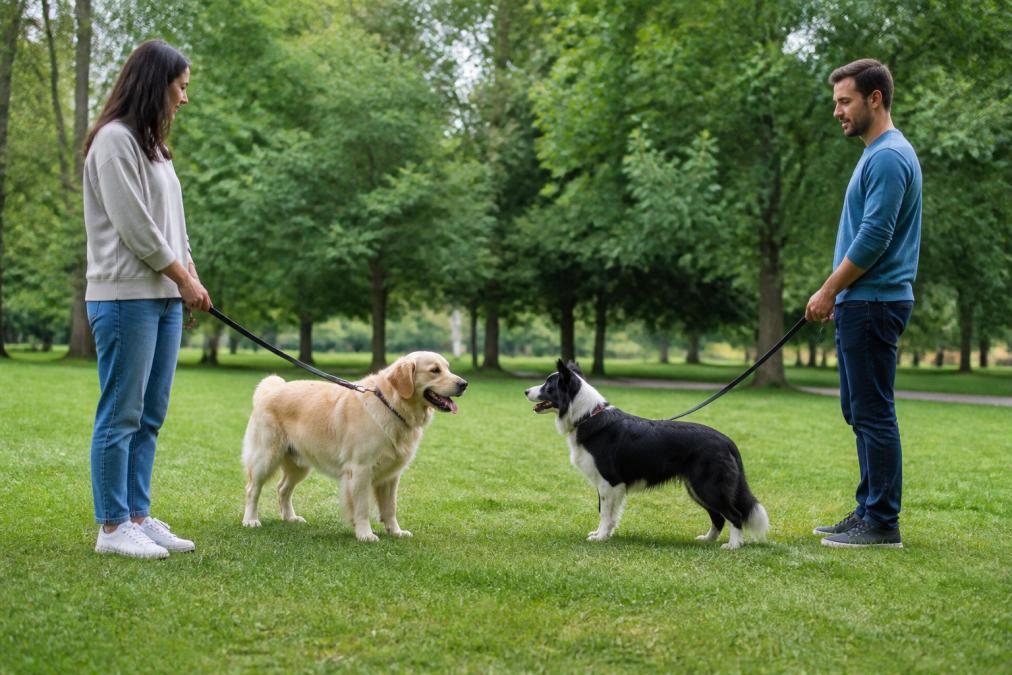
The first meeting should happen on neutral territory, a park, quiet sidewalk, or friend's fenced yard, never in the resident dog's home, so it can't guard its turf.
Pick the Right Spot and Keep Leash Control
Choose a low-traffic spot with room to move; avoid dog parks. Keep both dogs on loose leashes, a tight leash signals tension. Start 10 to 15 feet apart and walk the dogs parallel, letting them get used to each other's presence without a face-to-face standoff.
Watch for calm signals:
- Loose, wiggly body
- Soft eyes and relaxed ears
- Curious sniffing toward the other dog
- Play bows
Your Dog Introduction Timeline: What Happens Day by Day
Most successful introductions unfold over weeks, not hours. A dog introduction timeline gives both animals time to adjust without pressure; rushing is the biggest mistake.
The 30-Day Transition Period at a Glance
Follow this schedule, adjusting the pace to match your dogs.
| Phase | Days | Focus | Key Action |
|---|---|---|---|
| Settle in | 1-3 | New dog decompresses | Separate rooms, no meeting |
| First contact | 4-7 | Neutral-ground walks | Parallel walking, short sessions |
| Home meetings | 8-14 | Supervised time | Leashed greetings indoors |
| Supervised play | 15-21 | Free interaction | Short play, close watching |
| Normal routine | 22-30 | Full integration | Shared spaces, ongoing checks |
The Regression Window: What to Do When They Fight 48 Hours Later
The first meeting goes fine, then two days later there's a snap over a food bowl. That's not failure, it's the regression window, and it's predictable. During the first 24 to 72 hours, elevated cortisol keeps both dogs in a low-arousal, high-caution state that suppresses conflict. As the new dog's cortisol drops, its real personality, energy, and resource drive come online, and the resident dog has noticed its routine and attention are being shared.
A common pattern looks like this:
- Days 1-2: Calm, almost suspiciously easy. Both dogs avoid each other.
- Days 3-5: New dog starts testing space. Resident dog starts hovering near resources.
- Days 5-14: First real conflict. Usually over food, a favored toy, a doorway, or your lap.
The 72-hour reset protocol:
- Separate the dogs completely for 48 hours, no visual contact, no shared walks. This is a hormonal reset, not punishment.
- Resume parallel walking on neutral ground, 10 to 15 feet apart, twice a day for 15 minutes.
- Reintroduce indoor time behind a barrier before any off-leash contact.
- Identify the trigger. If it was food, feed in separate closed rooms from now on. If it was a person, that person stops petting both dogs at once.
- Rebuild in shorter increments: five-minute sessions, not fifteen.
Watch for These Regression Triggers
Certain events reliably reopen conflict:
- A new person or pet enters the home
- A change in feeding schedule or location
- One dog returns from the vet smelling different
- A vacation, move, or household disruption
- The new dog reaching full physical maturity (often 18 to 24 months)
When any of these hit, drop back one phase on the timeline table and rebuild for a few days. That's normal maintenance, not a setback.
Adjusting the Pace for Your Pair
A few variables change your pace:
- Age gap: A senior resident dog with a puppy usually needs the puppy crated or gated more, not less. Puppies read as rude to older dogs.
- Size gap: A large new dog and a small resident dog should stay leashed indoors longer, even after outdoor walks go well.
- Sex: Two intact dogs of the same sex are the highest-risk pairing for conflict. Spaying or neutering before introduction reduces but does not eliminate the risk.
- Prior history: A rescue dog with an unknown history needs the full 30 days. A well-socialized dog from a foster home with other dogs can often compress to two weeks.
Plan for 30 days, expect a regression around day 5 to 14, and treat it as information rather than failure. The pairs that succeed long-term are the ones whose owners slowed down at the first sign of friction instead of pushing through it.
First Meetings at Home: Parallel Walking and Supervised Play
Bring the neutral-ground routine indoors. Keep both dogs leashed for the first few home meetings. Walk them through the house side by side, then let them sniff a shared room.
Watch for these signs that play is going well:
- Both dogs take turns chasing
- Play bows appear
- Pauses happen naturally
- Bodies stay loose
Short, positive sessions beat long ones. Five calm minutes repeated daily builds more trust than one long, chaotic hour.
Reading Body Language: Stress Signals, Hackles, and Aggression Cues
Dogs talk with their bodies in a predictable order. Learning the escalation ladder prevents most problems, because you intervene at the first rung instead of the fifth.
The Escalation Ladder
Behaviorists describe canine communication as a ladder a dog climbs one rung at a time, giving the other dog (and you) a chance to back off. Problems happen when a dog is punished for the lower rungs and learns to skip to the top.
Rung 1, Displacement signals (mild stress):
Dog Kennel Furniture, Wooden Dog Crate →
- Lip licking with no food present
- Yawning when not tired
- Sniffing the ground suddenly mid-interaction
- Turning the head away
- Slow, stiff tail wag
Rung 2, Avoidance (moderate stress):
- Whale eye (whites of the eyes showing as the dog looks away)
- Tucked tail
- Ears pinned back
- Crouching or lowering the body
- Walking away from the other dog
Rung 3, Arousal without intent (gray zone):
- Hackles raised along the spine
- High, fast, stiff tail wag
- Whining or barking during play
- Mounting
- Body blocking
Rung 4, Warning (stop now):
- Hard, unbroken stare
- Freezing mid-motion
- Growl with a forward lean and weight shifted onto the front legs
- Lip curl showing teeth
- Snapping at air
Rung 5, Bite:
The Two-Second Rule
Here's a practical threshold most owners don't know: if a signal lasts longer than about two seconds without the other dog responding, it's no longer communication. It's a dog stuck in a stress state.
Watch for signals that freeze in place:
- A stare that holds for three or more seconds
- A tucked tail that doesn't relax when the other dog moves away
- A lip lick repeated three or more times in a minute
- A play bow that never resolves into actual play
Play vs. Conflict: The Same Signals, Different Rhythm
Many of the signals above appear in healthy play. The difference is rhythm.
Healthy play has:
- Role reversals (the chaser becomes the chased)
- Play bows that reset the action
- Self-handicapping (a bigger dog lying down to match a smaller one)
- Pauses every 10 to 30 seconds
- Loose, bouncy, inefficient movement
Play tipping into conflict has:
- One dog always on top, always winning
- No pauses, or pauses where the pinned dog can't get up
- Stiff, efficient, direct movement
- One dog repeatedly trying to disengage while the other follows
- Vocalization that escalates rather than punctuates
What a Wagging Tail Actually Means
A wagging tail is an arousal meter, not a happiness meter, position and speed tell you which direction it's going.
- High, fast, stiff wag: High arousal, often with tension. Common in dogs guarding a resource or greeting a stranger they're unsure about.
- Mid-height, loose, wide sweep: Relaxed and friendly. This is the wag you want.
- Low, fast, tucked wag: Appeasement or anxiety. The dog is nervous, not happy.
- Tail tucked completely: Fear. Give space.
When to Call a Professional
DIY body-language reading has limits. Call a certified trainer or veterinary behaviorist if:
- You see Rung 4 signals more than once
- A growl is met with a growl
- One dog cannot relax even at a distance
- You're missing signals faster than you can respond
Read the ladder, not the moment. Intervene at Rung 1 or 2 and you'll rarely see Rung 4. Punish the growl and you'll skip straight to the bite.
Setting Boundaries, Rules, and Resource Guarding Prevention
Resource guarding, defending food, toys, or a favorite person, is one of the most common reasons new-dog introductions fail.
Prevent it with simple rules:
- Feed the dogs in separate rooms
- Pick up toys after play
- Give each dog its own bed and crate
- Never take a toy or bone directly from a dog's mouth
Trade up instead of taking away. If a dog guards a toy, offer a higher-value treat in exchange. This teaches that giving up an item leads to something better, not a loss.
When to Intervene and When to Call a Trainer
Step in the moment you see real aggression cues; don't wait for a fight to confirm what you saw.
Intervene if you notice:
- A hard stare that won't break
- A growl with a forward lean
- One dog pinning or cornering the other
- Snapping or a bite
Call a certified trainer or veterinary behaviorist if:
- Fights have already happened
- One dog shows fear that won't fade
- Resource guarding is intense
- You feel unsafe managing the pair
Conclusion
Introducing a new dog takes patience, planning, and a calm hand. Rushing sets both dogs back.
Frequently Asked Questions
What should I avoid when introducing a new dog to my home?
Skip face-to-face greetings at the front door, and never hold both dogs' leashes if you can bring a second person. Avoid the dog park, high-value toys, and food bowls on day one. Don't force interaction if either dog freezes, stiffens, or tries to hide. Keep the first meeting short, then separate the dogs so they can rest.
How long does it take for a new dog to adjust to a household?
Plan for a 30-day dog introduction timeline, with the first three days for decompression, the first three weeks for settling into routines, and the first three months for full comfort. Some dogs settle in a week; others need the full three months. Watch for returning appetite, relaxed sleeping, and play bows as signs the transition period is working.
What are the signs that a dog introduction is going well?
Look for loose, wiggly body language, soft eyes, and play bows. Sniffing behavior, parallel walking without tension, and taking turns investigating the yard all point to a healthy start. Hackles that stay down, tails that wag in a wide arc, and a submissive posture from the new dog are also good signs. Freezing, hard stares, or tucked tails mean slow down.
Should I keep my new dog separated from my other pets at first?
Yes. Use a crate, a freestanding pet barrier, or a closed door for the first few days so both dogs can smell and hear each other without direct contact. The Freestanding Pet Barrier from Shake Wag & Roll sets up in 30 seconds and gives you a movable boundary for doorways, hallways, or stairs. Short, supervised meetings beat long, chaotic ones.