

How to Keep Your Dog Cool During Summer: 7 Steps

Table of Contents
- Why Dogs Overheat Faster Than You Do
- Signs of Heatstroke in Dogs You Should Never Ignore
- Step 1: Set Up Shade and Cool Resting Spots
- Step 2: Time Walks Around the Heat, Not the Clock
- Step 3: Dog Paw Pad Protection for Hot Pavement
- Step 4: Cooling Treats for Dogs That Actually Work
- Step 5: Water, Pools, and Post-Exercise Cooling
- Step 6: Know Which Breeds Struggle Most in Heat
- Step 7: Build a Daily Summer Cooling Routine
- Frequently Asked Questions
Last Updated: September 22, 2026
Why Dogs Overheat Faster Than You Do
Dogs run hotter than humans, and it is not close. A normal canine body temperature sits between 101 and 102.5 degrees Fahrenheit, while ours hovers near 98.6. That gap matters more than most owners realize.
Signs of Heatstroke in Dogs You Should Never Ignore
Heatstroke in dogs is a life-threatening emergency, not a "wait and see" situation. Knowing the early signs, and what to do in the first ten minutes, is what separates a full recovery from organ damage.
- Heavy panting that does not slow down even at rest
- Excessive drooling or thick, sticky saliva
- Bright red gums and tongue
- Lethargy, wobbling, or reluctance to stand
- Vomiting or diarrhea
- Confusion, glazed eyes, or staring
- Collapse, seizures, or unconsciousness
When to Call an Emergency Vet
Call an emergency vet the moment you see confusion, collapse, vomiting, or a rectal temperature at or above 104 degrees Fahrenheit. Do not wait to see if your dog improves on its own. While you call, start cooling, every minute of delay raises the risk of lasting damage.
The First 10 Minutes: A Cooling Protocol
Speed matters, but so does method. Cooling too aggressively can cause shock, so follow a graduated approach:
- Move your dog out of the heat immediately. Shade, air conditioning, or a fan. Stop all activity.
- Offer cool, not ice-cold, water to drink. Let your dog drink freely, but do not force water into its mouth.
- Wet the body with cool tap water. Focus on the neck, armpits, groin, and belly, the areas with the most blood flow near the surface. A garden hose on a cool setting, a wet towel, or a shallow tub all work.
- Keep air moving over the wet coat. A fan or a car air conditioner on the drive to the clinic accelerates evaporation.
- Skip ice packs and ice baths. Ice constricts surface blood vessels and can trap heat in the core, and it can push a dog into shock. Cool water is safer and works faster.
- Take a rectal temperature if you have a thermometer. A normal canine temperature is 101 to 102.5 degrees Fahrenheit. Stop active cooling once you reach 103 degrees to avoid overshooting into hypothermia.
- Drive to the nearest emergency clinic. Call ahead so the team is ready when you arrive.
After the Emergency
Even if your dog seems to recover on the drive, follow up with a veterinarian. Heatstroke can cause delayed clotting problems, kidney injury, and gastrointestinal damage that show up hours later. Bloodwork is often recommended within 24 hours.
Step 1: Set Up Shade and Cool Resting Spots
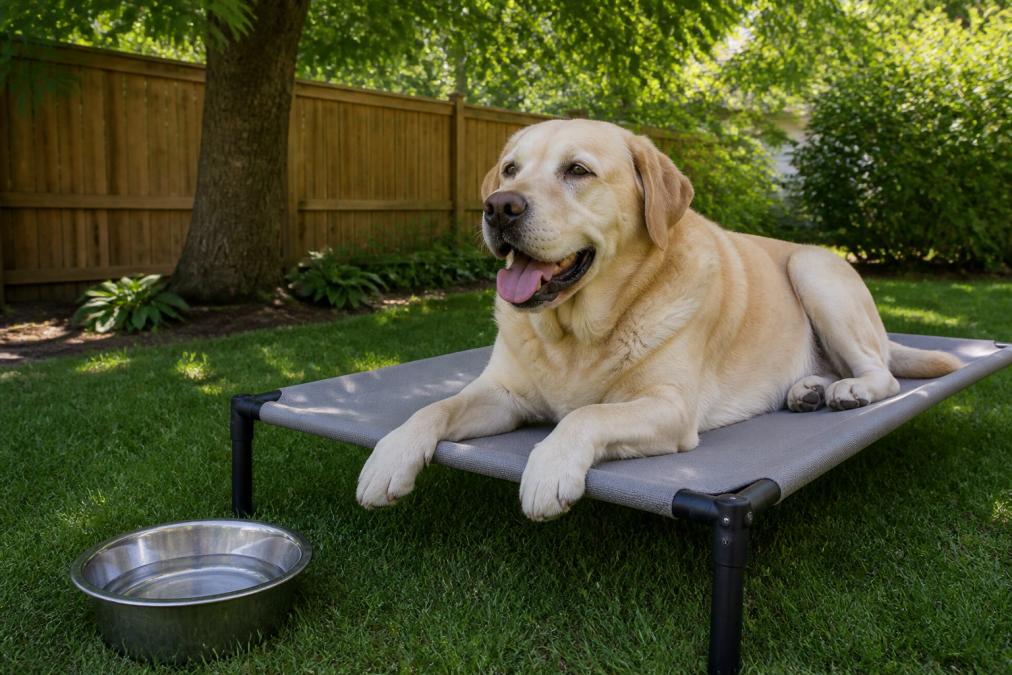
Shade is the fastest cooling tool you own, and it costs nothing. A shaded area can feel 10 to 15 degrees cooler than direct sun.
Elevated Beds That Let Air Circulate
An elevated bed lifts your dog off hot ground and lets air move underneath. That airflow cools the belly and underarms, two areas where dogs lose heat.
Step 2: Time Walks Around the Heat, Not the Clock
Walk your dog in the early morning or late evening, not at midday. The pavement, not the air, is usually the real danger.
The Humidity Factor Most Owners Miss
Humidity matters as much as temperature, and most owners never check it. Dogs cool by panting, which works through evaporation. When the air is already full of moisture, that evaporation slows to a crawl.
Step 3: Dog Paw Pad Protection for Hot Pavement
Dog paw pad protection for hot pavement starts with one rule: if it burns your hand, it burns their paws. Pavement burns are painful and slow to heal.
Try these protections:
- Walk on grass or dirt paths instead of asphalt
- Go out before 9 a.m. or after 7 p.m.
- Use paw wax or booties for short trips
- Carry your dog across hot parking lots
- Check paws after every walk for redness or blisters
Step 4: Cooling Treats for Dogs That Actually Work
Cooling treats for dogs work best when they combine cold temperature with licking, which releases heat from the mouth. Frozen treats do both.
Step 5: Water, Pools, and Post-Exercise Cooling
Fresh water and a place to wade are the core of any summer cooling plan. Dogs lose water fast through panting, so refill bowls often and carry water on every walk.
Step 6: Know Which Breeds Struggle Most in Heat
Breed matters more than most owners think, and the reason is mechanical, not cosmetic. How a dog is built determines how well it can move air, and moving air is how dogs cool down.
Why Flat-Faced Breeds Overheat Fastest
Brachycephalic dogs, the flat-faced breeds, have shortened skulls and narrow airways. That anatomy makes every breath more work. Pugs, Bulldogs, French Bulldogs, Boston Terriers, Boxers, Shih Tzus, and Pekingese all fall into this group.
Double-Coated Breeds: The Counterintuitive Case
Huskies, Malamutes, Samoyeds, Chow Chows, and other double-coated breeds are built for cold. Their dense undercoat insulates against heat loss, which is exactly the wrong trait in summer. Many owners shave these dogs, but that is usually a mistake, the topcoat reflects sun and the undercoat regulates temperature. Shaving can make them hotter and increases sunburn risk.
Other High-Risk Groups
- Senior dogs, slower circulation and weaker panting reflexes
- Overweight dogs, extra fat insulates and adds metabolic heat
- Dogs with heart or respiratory disease, panting strains an already-taxed system
- Dark-coated dogs, absorb more solar heat
- Very young puppies, immature cooling systems
The Humidity Multiplier
Here is the factor most owners never check: humidity. Dogs cool by panting, and panting works through evaporation. When the air is already saturated with moisture, evaporation slows to a crawl, no matter what the thermometer says.
A Quick Breed Risk Cheat Sheet
| Risk Level | Examples | Summer Plan |
|---|---|---|
| Highest | Pugs, Bulldogs, French Bulldogs, Boston Terriers, Boxers | Indoor only during peak heat; 10-minute walks at dawn and dusk |
| High | Huskies, Malamutes, Samoyeds, Chow Chows | Daily undercoat brushing; shade and AC; no shaving |
| Elevated | Seniors, overweight dogs, dark-coated dogs, puppies | Shorter walks, more water breaks, watch for early lethargy |
| Standard | Most short-coated, medium-nosed breeds | Normal routine with shade, water, and heat-index checks |
Knowing your dog's category lets you stop guessing and start planning. The goal is not to keep your dog indoors all summer, it is to match the day's conditions to what your dog's body can actually handle.
Step 7: Build a Daily Summer Cooling Routine
A routine beats a scramble. Build cooling into every hot day so you are never reacting to a crisis.
| Time of Day | Action | Why It Matters |
|---|---|---|
| Early morning | Walk before 9 a.m. | Coolest pavement and air |
| Midday | Indoor rest, fan, fresh water | Avoid peak heat |
| Afternoon | Frozen treat or chew toy | Cools mouth, eases stress |
| Evening | Second walk after 7 p.m. | Pavement has cooled |
| All day | Shade and water access | Prevents dehydration |
Frequently Asked Questions
How hot is too hot to walk my dog?
Veterinarians generally advise against walks when the pavement temperature exceeds 125°F, which can happen when air temperature is only 77°F and the sun is direct. A simple test: press the back of your hand to the pavement for seven seconds. If you cannot hold it there, it is too hot for your dog's paw pads. Shift walks to early morning or after sunset, and stick to grass or shaded trails when possible.
What are the early signs of heatstroke in dogs?
Watch for excessive drooling, heavy panting that does not slow down, lethargy, bright red gums, and skin that feels hot to the touch. As it progresses, a dog may vomit, have diarrhea, wobble, or collapse. A rectal temperature above 104°F signals heat exhaustion; above 106°F is an emergency. Move your dog to shade, apply cool (not ice-cold) water to the belly and paws, and call your vet immediately.
Can cooling treats for dogs really help prevent overheating?
Yes. Frozen treats lower body temperature from the inside while giving your dog something to lick, which releases heat through the mouth. Water-fillable chew toys that you freeze are a safe option because they contain no sugar or dairy. Avoid giving ice cubes to dogs that gulp them whole, as they can lodge in the throat. Offer frozen enrichment in the hottest part of the day instead of a midday walk.
Do some dog breeds handle heat worse than others?
Flat-faced breeds like Bulldogs, Pugs, and Boston Terriers are brachycephalic, meaning their shortened airways make panting less efficient. They overheat faster and should stay indoors during peak heat. Double-coated breeds such as Huskies and Malamutes also struggle. Thick-coated dogs should not be shaved, since the coat insulates against heat. Seniors, puppies, and overweight dogs face higher risk regardless of breed.
Summer heat is the one risk you can plan around, and your dog depends on you to do it. Shake Wag & Roll carries the gear that makes it easy, from the elevated mesh bed that keeps air moving under your dog to the freezable Lick and Gnaw toys that cool from the mouth out. Our community of dog lovers shares cooling tips, product drops, and expert canine care advice all season long. Get started with Shake Wag & Roll and give your dog a summer that is cool, safe, and full of good days.