

How to Train Large Dogs Not to Pull on Walks

Table of Contents
- Why Large Dogs Pull and What Makes It Harder to Fix
- Loose Leash Walking Training: A Step-by-Step Plan
- Choosing the Best Harness for Dogs That Pull
- What to Do When a Dog Pulls on Walks
- How Long Does Leash Training Take for a Large Dog?
- Troubleshooting: When Your Large Dog Still Pulls
- Frequently Asked Questions
Last Updated: October 14, 2026
Why Large Dogs Pull and What Makes It Harder to Fix
Learning to train large dogs not to pull starts with understanding why it happens. A big dog that leans into the leash is not stubborn or dominant, it is doing what feels natural, and the leash has taught it that pulling works.
The core problem: dogs move toward what they want. When your dog pulls and you keep walking, the walk continues, that is a reward. Over time, tension equals forward motion.
The Pulling Cycle: How Reinforcement Works Against You
The pulling cycle repeats on almost every walk:
- Your dog sees something interesting and moves toward it.
- The leash goes tight.
- You follow, because stopping feels awkward.
- Your dog gets closer to what it wanted.
- The pulling gets stronger.
Large-Dog Safety and Handler Mechanics
A 90-pound dog that lunges can knock a person off balance, a safety issue, not just an obedience one. Handler mechanics matter more with big dogs:
- Hold the leash with two hands when your dog is likely to surge.
- Keep your elbow close to your body, not extended.
- Plant your feet shoulder-width apart before a known trigger appears.
For a high-drive dog, a sturdy harness and well-fitted leash are the base of every safe walk.
Loose Leash Walking Training: A Step-by-Step Plan
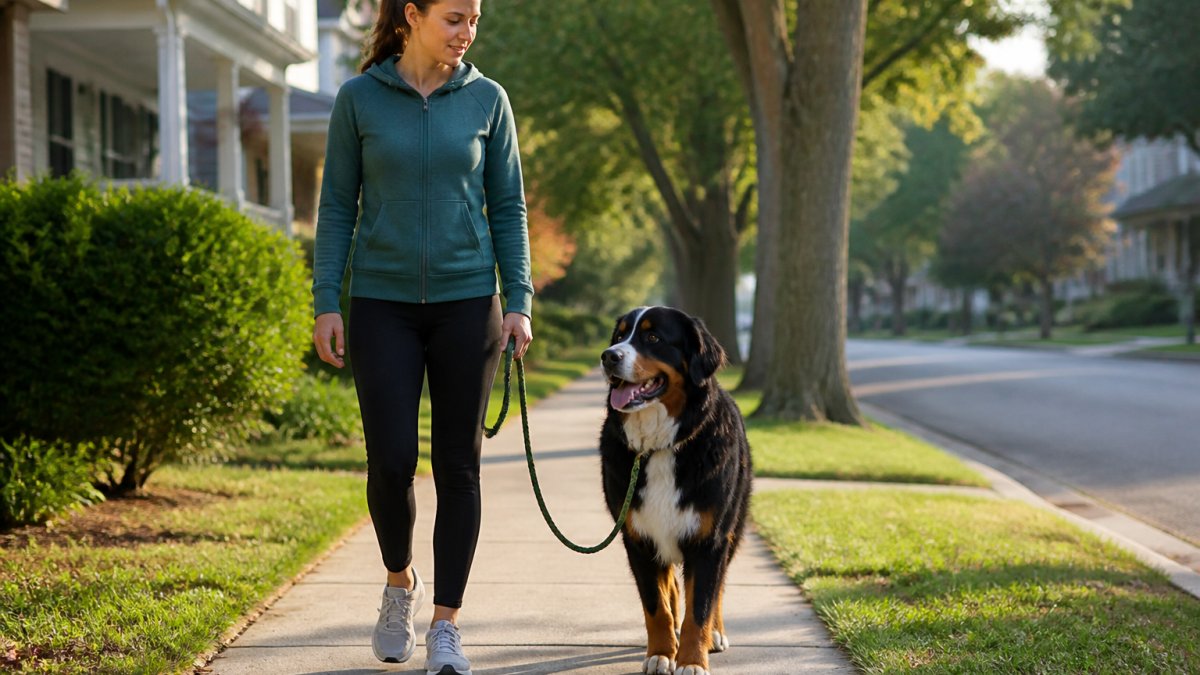
Loose leash walking training teaches your dog that a slack leash earns forward movement, while a tight leash stops it, the same principle you use to train large dogs.
How to Run Each Session
Before the stages, lock in the mechanics that apply to every session:
- Keep sessions to 5 to 10 minutes. Two short sessions a day beat one long one.
- Train before meals, not after. A slightly hungry dog works for food rewards.
- Train on a flat collar or a front-clip harness and a 4 to 6 foot leash. Skip retractable leashes; they teach a dog that tension pays out more line.
Stage 1: Indoor Hallway, Zero Distractions
Start where there is nothing to chase, a hallway or quiet room.

- Stand still with your dog on a slack leash at your side.
- Take one step. If the leash stays loose, mark it (a word like "yes" or a clicker) and reward.
- If the leash goes tight, stop. Do not pull back. Wait for it to slacken, then reward that moment.
Pass test: 10 steps, slack leash, indoors, no prompting.
Stage 2: Indoor Duration and Turns
Add length and direction changes indoors.
- Walk 20 steps with a slack leash.
- Add a turn every few steps. Reward when your dog stays with you through the turn.
- Add a stop-and-go pattern. Reward the stop, then the restart.
Pass test: 20 steps with two turns, slack leash throughout.
Stage 3: Yard or Driveway
Move outside, but stay on your own property. New smells are the first real distraction.
- Repeat the Stage 1 and 2 drills in the yard.
- If your dog surges toward a smell, stop. Wait for the check-in, then reward and continue.
- Keep the first outdoor sessions to three to five minutes.
Pass test: 20 steps in the yard with no more than one stop-and-wait.
Stage 4: Quiet Sidewalk
Now you are on public ground with real-world sights and sounds.
- Pick a low-traffic time and route.
- Walk 30 to 50 steps, rewarding the slack leash every few steps.
- If the leash goes tight, stop and wait. Change direction if your dog will not re-engage.
Pass test: One full block with a slack leash and no more than two stops.
Stage 5: Add Distractions at Distance
This is where impulse control gets built. Start far from the trigger, then close the gap over many sessions.
- Pick one distraction at a time: another dog, a person, a squirrel, a stroller.
- Begin where your dog notices but does not react, often 30 to 50 feet for a dog-reactive dog, closer for a merely curious one.
- Reward calm looking and check-ins. If your dog fixates or lunges, add distance and try again.
Pass test: Walk past one known trigger at half your starting distance with a slack leash.
Stage 6: Real Walks With Real Variables
Now combine everything on a normal walk.
- Vary the route, the time, and the pace.
- Reward heavily in the first five minutes, then taper to occasional rewards.
- Keep a treat pouch on you so rewards land within a second or two of the behavior.
Pass test: A 20-minute walk with a slack leash for most of the route and no more than three stops.
What to Do When You Get Stuck
If you stall at a stage for more than a week, the fix is almost always one of these:
- Too much distraction. Drop back one stage and rebuild.
- Too long a session. Cut it in half.
- Rewards too slow. Get the treat into your dog's mouth within one to two seconds of the correct behavior.
How to Track Progress
Keep a simple log. After each walk, note three things: distance walked with a slack leash, number of stops, and the biggest distraction your dog handled. Over two to three weeks, the trend tells you more than any single walk. If distance climbs and stops fall, you are on track.
Choosing the Best Harness for Dogs That Pull
The best harness for dogs that pull is a front-clip harness, because it redirects your dog's forward motion to the side instead of letting it lean straight ahead. A back-clip harness can make pulling worse, since it gives a big dog a solid point to pull against.
Front-Clip vs. Back-Clip: What Actually Changes Pulling
| Harness Type | Effect on Pulling | Best For | Watch Out For |
|---|---|---|---|
| Front-clip | Redirects motion to the side | Strong pullers, large dogs | Slight gait change if fit is off |
| Back-clip | Gives a strong pull point | Calm walkers, small dogs | Can worsen pulling in big dogs |
| No-pull vest | Spreads pressure across chest | High-drive dogs, daily walks | Needs correct sizing to work |
A well-fitted no-pull harness should sit snug across the chest without rubbing the shoulders. Check the fit after every growth spurt, especially with young large-breed dogs.
Our No Pull Service Dog Vest Harness is built for exactly this job. The breathable, soft design spreads pressure across the chest, which matters when you are managing a dog that weighs more than you want to wrestle.
What to Do When a Dog Pulls on Walks
What to do when a dog pulls on walks comes down to one rule: a tight leash means the walk stops. Your dog only moves forward when the leash is slack. Applied every time, that rule teaches more than any correction.
Stop, Change Direction, and Reward the Slack Leash
Run this routine every time your dog pulls:
- Stop walking the instant the leash goes tight.
- Wait, without pulling back, until your dog looks at you or the leash loosens.
- Change direction or step off to the side to break the forward pull.
- Reward the slack leash with a treat the moment it appears.
- Walk on only when the leash is loose.
It feels slow at first. That is normal, you are trading a few frustrating walks for months of easy ones.
Keep a treat pouch on you so rewards happen fast. Our Dog Training Crossbody Bag keeps treats within reach so you can reward the exact moment your dog gets it right.

For treats, small and low-calorie is best, since you will hand out a lot of them. Bixbi Trainer Treats are grain-free and about 3.9 calories per treat, easy to use often without overfeeding.

How Long Does Leash Training Take for a Large Dog?
Leash training for a large dog usually takes 4 to 8 weeks of consistent daily practice, though some dogs need longer. Progress depends on age, drive, and how long the pulling habit has been rewarded.
Track progress by small wins, not the calendar:
- Can your dog walk 10 steps with a slack leash indoors?
- Can it pass a doorway without surging?
- Can it hold a loose leash past one distraction?
Expect setbacks. A dog that nails it on Monday may forget everything on Friday when a squirrel appears. That is normal, not failure.
Troubleshooting: When Your Large Dog Still Pulls
If your large dog still pulls after weeks of work, the cause usually points to one of a few problems. Find the cause, and the fix gets obvious. The table below separates pulling by context; the sections after it cover cases that need more than a training tweak.
| Problem | Likely Cause | Fix |
|---|---|---|
| Pulls only outdoors | Too much distraction, too soon | Add distance, lower the challenge, drop back a stage |
| Pulls toward other dogs | Leash frustration or excitement | Reward calm at a distance, build up slowly, use a front-clip harness |
| Pulls the whole walk | Tight leash never corrected | Stop every time the leash goes tight, no exceptions |
| Pulls when tired | Not enough daily exercise | Add a run or fetch before walks |
| Pulls on one route only | Strong trigger on that route | Change the route while you train |
| Pulls harder when corrected | Aversive equipment or jerking | Switch to a front-clip harness and reward-based training |
| Pulls only with one person | Inconsistent handling | Align everyone on the same stop-and-wait routine |
Pulling Caused by Excitement
An excited puller surges toward the thing it wants: the park, a friend, another dog. The fix is to make forward motion contingent on a slack leash, every time. Use a front-clip harness so a sudden surge redirects to the side instead of pulling you forward.
Pulling Caused by Fear or Anxiety
A fearful dog pulls to get away from something, not toward it. The body language differs: tucked tail, lowered head, ears back, pulling sideways or backward. Do not correct this, adding pressure to a scared dog makes the fear worse. Instead, increase distance from the trigger, reward calm behavior, and keep sessions short.
Pulling Caused by Frustration
Leash frustration looks like a dog that lunges, barks, and spins when it cannot reach another dog or a person. The fix is distance and reward for calm, not punishment. Start far enough away that your dog can think, reward every calm look, and close the gap over many sessions.
Pulling Caused by Learned Habit
If your dog pulls on every walk regardless of what is around, the habit is the cause. The leash has been tight so long that tension feels normal. This is the most common pattern and the most fixable. It requires one rule applied every single walk: a tight leash means the walk stops.
When to Seek Professional or Veterinary Help
Some pulling is not a training problem. Get help if you see any of these:
- A sudden change in behavior. A dog that walked fine last month and now pulls hard, limps, or refuses to walk may be in pain. Neck, back, and joint issues are common in large breeds. See your veterinarian first.
- Reactivity with a bite risk. Growling, snapping, or lunging at people or other animals needs a qualified force-free trainer or veterinary behaviorist, not a YouTube video.
- You cannot physically hold the dog. If a 90-pound dog can pull you off your feet, safety comes before training. A trainer can assess equipment and handling, and a front-clip harness plus a properly fitted collar can make the difference.
Setbacks Are Part of the Process
A dog that nails it on Monday may forget everything on Friday when a squirrel appears. That is normal. A setback is not a reset. Drop back one stage, rebuild for a few sessions, and move forward again. The dogs that succeed are not the ones that never slip; they are the ones whose owners keep the rules the same on the bad days.
Frequently Asked Questions
What is the best way to stop a large dog from pulling on the leash?
The most effective approach combines a front-clip harness with consistent stop-and-redirect training. When your dog pulls, stop walking immediately and wait for the leash to go slack before moving again. Reward loose-leash behavior with high-value treats like grain-free trainer treats. Practice in short sessions of 5-10 minutes, several times a day, starting in low-distraction areas. Large dogs respond well to positive reinforcement paired with clear, unchanging rules about what earns forward movement.
Should I stop walking when my dog pulls?
Yes. Stopping the moment the leash goes tight teaches your dog that pulling ends the walk. Stand still, avoid yanking back, and wait for your dog to look back at you or create slack in the leash. Then reward and continue. If your dog pulls again, repeat. This works because forward motion is the reward your dog wants most. Consistency matters more than force, especially with large dogs that can easily overpower a handler.
How long does it take to train a dog not to pull?
Most dogs show meaningful improvement in 4-8 weeks with daily practice, though full reliability around distractions can take 3-6 months. Factors include your dog's age, breed drive, prior habits, and how consistently you train. Short, frequent sessions of 5-10 minutes work better than long ones. Older dogs can absolutely learn loose-leash walking; they just may need more repetitions and patience. Track small wins like fewer tight-leash moments per walk.
What is the best leash or harness for a large dog that pulls?
A front-clip no-pull harness paired with a 4-6 foot flat leash gives you the most control without putting pressure on your dog's throat. Front-clip designs redirect forward motion sideways, which is especially helpful for large dogs. Look for padded straps, adjustable sizing, and breathable materials for comfort on long walks. Avoid retractable leashes, which teach pulling, and choke or prong collars, which can cause injury and increase reactivity in strong dogs.
Every walk with a strong dog should feel safe and calm, not like a contest you keep losing. The fix is not strength or a harsher tool. It is a clear system, the right gear, and rewards delivered at the right moment. Shake Wag & Roll helps you get there with a breathable no-pull harness, a treat pouch that keeps rewards ready, and grain-free trainer treats that make every good choice worth repeating. Get started with Shake Wag & Roll and turn your daily walk into the best part of your dog's day.