

Are Premium Dog Collars Worth It? A 2026 Cost Breakdown

Table of Contents
- How to Tell a Premium Dog Collar From a Cheap One
- Leather vs Nylon Dog Collars: Which Lasts Longer?
- The Cost-Per-Use Math Behind Premium Dog Collars
- Durable Dog Collars for Active Dogs and Strong Pullers
- How to Measure for a Dog Harness Correctly (and Fit a Collar)
- Hardware Failure, Allergies, and Breed-Specific Safety
- Frequently Asked Questions
Last Updated: September 24, 2026
How to Tell a Premium Dog Collar From a Cheap One
A premium dog collar is a collar built with reinforced stitching, corrosion-resistant hardware, and materials rated to hold up under daily load, rather than one assembled from the cheapest components that will hold a buckle. That distinction decides whether you replace the collar every few months or every few years.

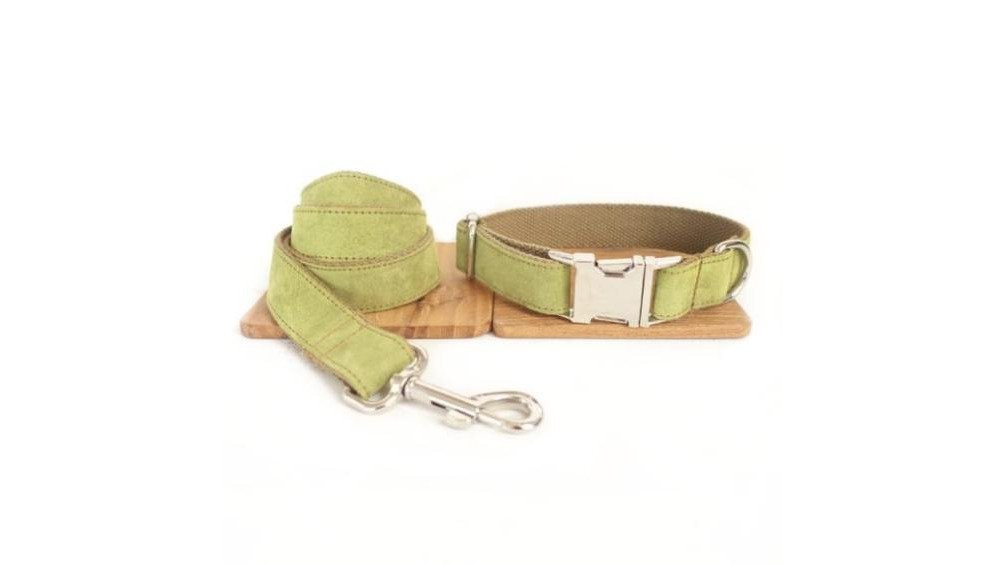
Hardware: The Weak Point on Most Collars
Hardware is where inexpensive collars fail first. A stamped-steel buckle bends under a hard pull; a welded D-ring holds. Look for a solid, corrosion-resistant D-ring and a buckle with no visible seam or flex. Zinc alloy hardware with a solid D-ring, like the gold-toned fittings on the Shake Wag & Roll collar and leash sets, is a good benchmark for what "premium" should mean.
Stitching, Fraying, and Tensile Strength
Stitching quality determines how long a collar survives. Reinforced, box-stitched seams spread load across the webbing instead of concentrating it at one point. On a cheap collar, you will see single-line stitching, loose thread ends, and fraying at the buckle within weeks. On a well-made one, the stitching sits tight and even along the full length.
Leather vs Nylon Dog Collars: Which Lasts Longer?
Full-grain leather generally outlasts nylon webbing for everyday wear, while nylon wins on water resistance and price. The trade-off is maintenance: leather needs conditioning to stay supple, and nylon needs replacing once the weave frays. But the reason each material behaves that way comes down to fiber structure, and that is what actually determines the replacement cycle.
Why Leather Lasts
Full-grain leather is the outermost layer of the hide, with the tight fiber network intact. Those fibers slide against each other under load, which is why a quality leather strap softens and conforms to the neck instead of cracking at a stress point. The failure mode is moisture: repeated soaking and drying strips the natural oils, the fibers stiffen, and cracks form at the buckle fold.
Why Nylon Frays
Nylon webbing is woven from continuous synthetic filaments. It resists water and rot, which is why it is the default for dogs that swim. Its weakness is abrasion and UV exposure. The weave abrades against the buckle and D-ring contact points, individual filaments break, and the strap begins to fray at the edges. Once fraying reaches the stitching line, the seam loses holding power.
Side-by-Side on the Factors That Decide Replacement
| Factor | Full-Grain Leather | Nylon Webbing |
|---|---|---|
| Lifespan | Years with conditioning | 12-24 months typical for active use |
| Water resistance | Poor without treatment | Good |
| Comfort fit | Softens and conforms with wear | Stiff until broken in |
| Cleaning | Wipe, then condition every few months | Hand wash, air dry |
| Primary failure mode | Cracking at the buckle fold | Fraying at abrasion points |
| Best for | Everyday and dress wear | Swimming and muddy trails |
The Materials Most Guides Skip
Beyond leather and nylon, two options deserve a mention because they change the durability math. BioThane is a coated webbing, a polyester core with a polymer coating, that combines nylon's water resistance with leather's wipe-clean surface and does not fray the way bare nylon does. It is common in working-dog and scent-work circles for exactly that reason. Recycled or solution-dyed nylon is another option: solution dyeing puts color in the fiber rather than on it, so it resists fading and does not leach dye onto a light-colored coat.
The Cost-Per-Use Math Behind Premium Dog Collars
Cost-per-use, not sticker price, is the honest way to judge whether premium dog collars are worth it. Divide the purchase price by the number of months the collar actually lasts. A cheap collar replaced three times a year usually costs more per month than one well-built collar that lasts several years.
The math is simple:
- Cost-per-use = Price ÷ Months of service
- A collar at $32.19 that lasts three years costs about $0.89 per month.
- A discount collar replaced every four months costs more per month, every month, for years.
Durable Dog Collars for Active Dogs and Strong Pullers
Durable dog collars for active dogs need three things: reinforced stitching, a solid D-ring, and a width matched to the dog's size. A strong puller puts continuous load on the hardware, so tensile strength and hardware integrity matter more than aesthetics. For dogs that pull hard, a wider collar spreads pressure across the neck instead of digging in.
How to Measure for a Dog Harness Correctly (and Fit a Collar)
To measure for a dog harness correctly, wrap a soft tape around the widest part of the dog's ribcage, just behind the front legs, and keep the tape snug but not tight. For a collar, measure the neck at its widest point and add two fingers of slack.
- Measure the neck at its widest point, not the base.
- Add two fingers of slack for the final size.
- Recheck monthly for puppies and every few months for adults.
- Match collar width to the dog's size and pull strength.
Hardware Failure, Allergies, and Breed-Specific Safety
Hardware failure and skin sensitivity are the two risks most collar guides skip. A quick-release buckle that pops open under load, or a D-ring that pulls free, turns a walk into an emergency. Understanding how each piece fails is what lets you inspect a collar before you trust it.
Buckle Types and How They Fail
There are two buckle families on the market, and they fail differently.
Allergy and Skin Sensitivity
The most common contact allergen in collar hardware is nickel, which is used in plating on inexpensive buckles and D-rings. A dog with a nickel sensitivity will show redness, thinning hair, or itching in a band around the neck, often worst where the metal sits. Coated hardware, powder-coated or polymer-coated, puts a barrier between the metal and the skin. Solid brass and stainless steel are also lower-reactivity options, though they cost more.
Breed-Specific Sizing
Collar width should scale with neck size and pull strength, not with the dog's overall size. A narrow collar on a thick-necked breed concentrates pressure into a thin band, which is uncomfortable and can dig in under load. A wide collar on a small dog is heavy, stiff, and can rub the trachea. As a rough guide, small breeds and toy breeds do well with a 5/8-inch collar, medium breeds with 3/4-inch to 1-inch, and large or strong-pulling breeds with 1-inch to 1.5-inch.
| Problem | Fix | Impact |
|---|---|---|
| Side-release buckle pops open | Match buckle load rating to dog's weight | Prevents escapes |
| D-ring pulls free | Choose a welded, solid D-ring | Keeps the leash attached |
| Skin irritation | Use coated or hypoallergenic hardware | Stops itching and redness |
| Collar too narrow | Match width to neck size and pull strength | Spreads pressure evenly |
| Collar too wide on small dog | Step down to 5/8-inch | Reduces weight and rubbing |
Frequently Asked Questions
What features define a premium dog collar?
Look at the hardware first. A solid zinc alloy or stainless steel D-ring, a quick-release buckle that does not bend under load, and reinforced stitching at stress points separate premium builds from budget ones. Materials matter too: full-grain leather, nylon webbing, or Biothane hold up to wear and tear better than thin fabric or bonded leather. Weather-resistant coatings and reflective materials add safety for evening walks. If the buckle feels flimsy or the D-ring flexes, the collar will not survive an active dog.
Are leather dog collars more durable than nylon?
It depends on the leather and the nylon. Full-grain leather develops a patina, resists fraying, and can last years with occasional conditioning, which is why many trainers recommend it for strong pullers. Nylon webbing is lighter, dries faster, and costs less, but cheap nylon frays at the edges and fades in sunlight. Biothane, a coated webbing, combines nylon's water resistance with leather-like toughness. For a dog that swims daily, nylon or Biothane wins. For a dog that mostly walks on leash, full-grain leather is the better long-term investment.
How often should you replace a dog collar?
Inspect the collar monthly and replace it when you see fraying, cracked leather, a bent D-ring, or stitching that has pulled loose. A cheap collar on an active dog may need replacing every six to twelve months. A premium collar with corrosion-resistant hardware and reinforced stitching can offer a significant cost-per-use advantage. Puppy growth stages are the exception: young dogs outgrow sizes quickly, so buy adjustable collars until they reach adult size.
Do expensive dog collars provide better safety for active dogs?
They often do, because safety comes down to hardware integrity. A buckle that releases under pressure or a D-ring that snaps mid-walk can let a dog bolt into traffic. Premium collars use tested buckles, welded or solid D-rings, and reinforced stitching that resists breakage during sudden pulls. Reflective materials and identification tags add visibility and a faster return if your dog slips away. The collar itself is only part of the system; pair it with a well-fitted harness for dogs that pull hard.
The hard part is not deciding whether premium is worth it. It is finding a collar where the hardware, stitching, and fit all hold up to the claim. Shake Wag & Roll stocks collars built for that standard, from the $32.19 soft comfort collar in five sizes to the full-grain leather set with European steel hardware, plus a waterproof LED collar for evening walks. Sign up with Shake Wag & Roll and get expert canine care tips, exclusive offers, and new product drops before anyone else.